
The Korean Alphabet: Hangul (Hangeul) Letters, Chart and Pronunciation
The Korean alphabet (Hangul) has 40 letters. See the chart of Korean letters with names and sounds, how syllable blocks work, and how to start reading fast.
What is the Korean alphabet (Hangul)?
The Korean alphabet, called Hangul (Hangeul), has 24 basic letters, 14 consonants and 10 vowels, plus 16 combined letters, which makes 40 in all. Letters are not written in a row like English ones: they are stacked into square syllable blocks such as 한 and 글, and you read one block at a time. Use the chart on this page to match every letter to its sound, then follow the links to the consonant, vowel and syllable pages.
Korean alphabet: counts and where to go next
Korean alphabet
Korean alphabet · Hangul
Hangul chart: every Korean letter with its sound
Tap a letter to hear it. Tap its name to open its page.
Basic consonants 14
Double consonants 5
| Consonant | Name | Start sound | End sound |
|---|---|---|---|
| ㄱ | 기역 (giyeok) | g | k |
| ㄲ | 쌍기역 (ssanggiyeok) | kk | k |
| ㄴ | 니은 (nieun) | n | n |
| ㄷ | 디귿 (digeut) | d | t |
| ㄸ | 쌍디귿 (ssangdigeut) | tt | — |
| ㄹ | 리을 (rieul) | r | l |
| ㅁ | 미음 (mieum) | m | m |
| ㅂ | 비읍 (bieup) | b | p |
| ㅃ | 쌍비읍 (ssangbieup) | pp | — |
| ㅅ | 시옷 (siot) | s | t |
| ㅆ | 쌍시옷 (ssangsiot) | ss | t |
| ㅇ | 이응 (ieung) | silent | ng |
| ㅈ | 지읒 (jieut) | j | t |
| ㅉ | 쌍지읒 (ssangjieut) | jj | — |
| ㅊ | 치읓 (chieut) | ch | t |
| ㅋ | 키읔 (kieuk) | k | k |
| ㅌ | 티읕 (tieut) | t | t |
| ㅍ | 피읖 (pieup) | p | p |
| ㅎ | 히읗 (hieut) | h | t |
| Vowel | Name | Sounds like | Sits |
|---|---|---|---|
| ㅏ | 아 (a) | a, as in arm | right of the consonant |
| ㅐ | 애 (ae) | ae, between the a of bad and the e of bed | right of the consonant |
| ㅑ | 야 (ya) | ya, as in yacht | right of the consonant |
| ㅒ | 얘 (yae) | yae, a rare glide that sounds close to ye | right of the consonant |
| ㅓ | 어 (eo) | eo, as in the u of sun | right of the consonant |
| ㅔ | 에 (e) | e, as in egg | right of the consonant |
| ㅕ | 여 (yeo) | yeo, like yu in young | right of the consonant |
| ㅖ | 예 (ye) | ye, as in yes | right of the consonant |
| ㅗ | 오 (o) | o, as in oh | below the consonant |
| ㅘ | 와 (wa) | wa, as in water | right and below |
| ㅙ | 왜 (wae) | wae, like the we in wet | right and below |
| ㅚ | 외 (oe) | we, as in wet | right and below |
| ㅛ | 요 (yo) | yo, as in yo-yo | below the consonant |
| ㅜ | 우 (u) | oo, as in moon | below the consonant |
| ㅝ | 워 (wo) | wo, as in won | right and below |
| ㅞ | 웨 (we) | we, as in wet | right and below |
| ㅟ | 위 (wi) | wi, as in we | right and below |
| ㅠ | 유 (yu) | yu, as in you | below the consonant |
| ㅡ | 으 (eu) | eu, with spread, flat lips | below the consonant |
| ㅢ | 의 (ui) | ui, from eu sliding to ee | right and below |
| ㅣ | 이 (i) | ee, as in bee | right of the consonant |
The chart below lists all 19 consonants and all 21 vowels in dictionary order. Consonants show the sound at the start of a block and the sound at the end, and vowels show how they sit beside the consonant.
Free printable worksheet sets
Three ready-to-print packs. Flip through the pages first, then download the PDF for your paper size.
Pack · Level 1 · Letters
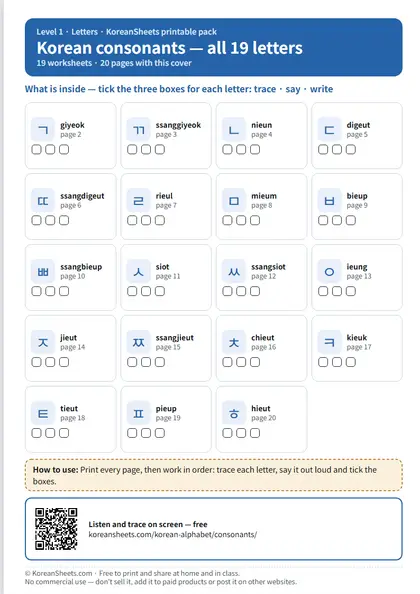
Korean consonants worksheet: all 19 letters
Trace, say and write every consonant from ㄱ to ㅎ, one letter per page.
- 20 pages
- A4 · US Letter
- PDF · 1.5 MB
- Free · no sign-up
After printing: hear every consonant on the consonants page
Worksheet information
- For
- Complete beginners of any age
- Inside
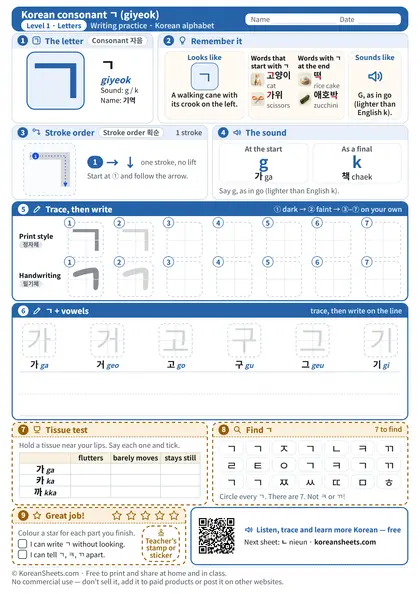
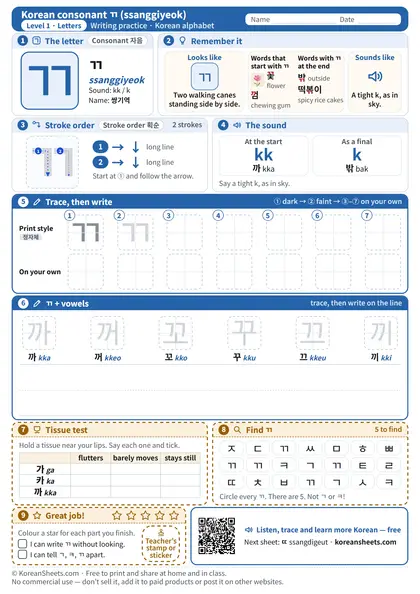
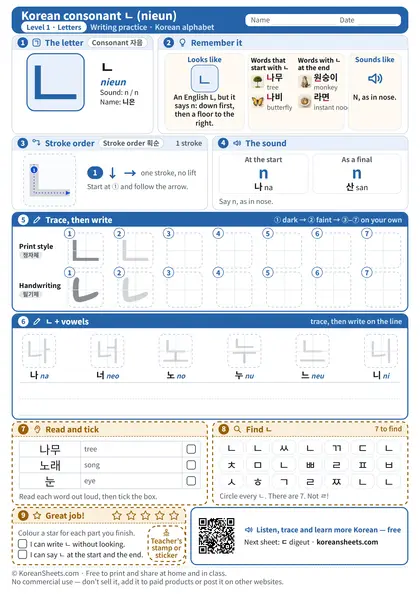
- A cover with a tick list, then 19 one-page tracing worksheets: stroke order, tracing, syllables and a find-the-letter game
- How to use
- Print every page, then work in order: trace each letter, say it out loud and tick the boxes.
Pack · Level 1 · Letters
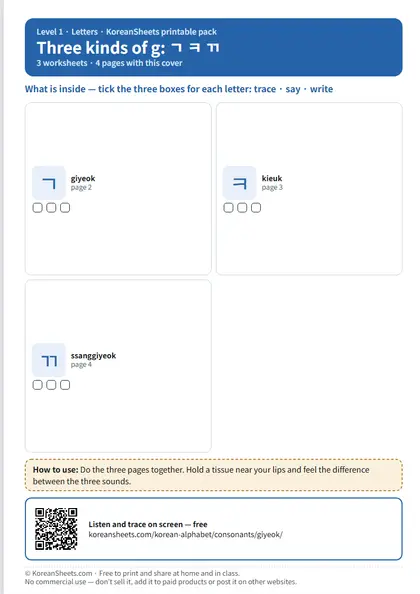
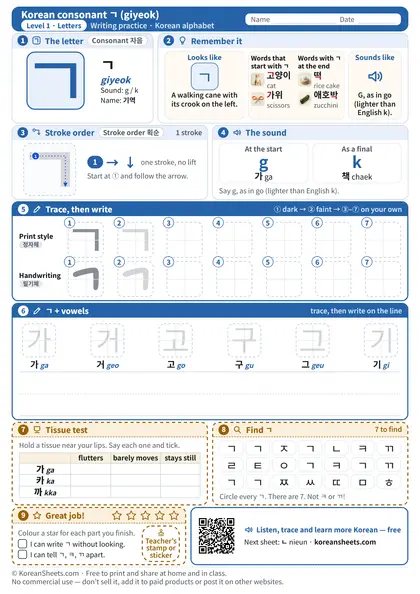
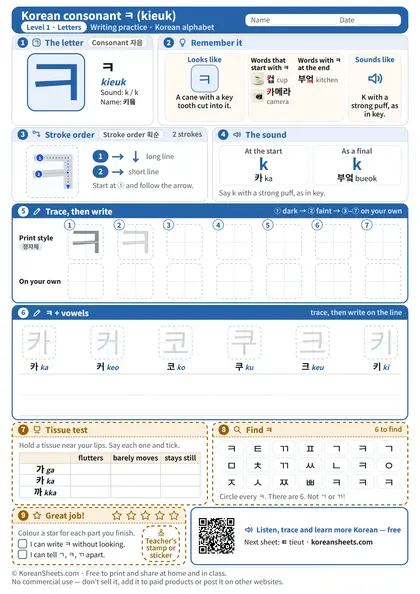
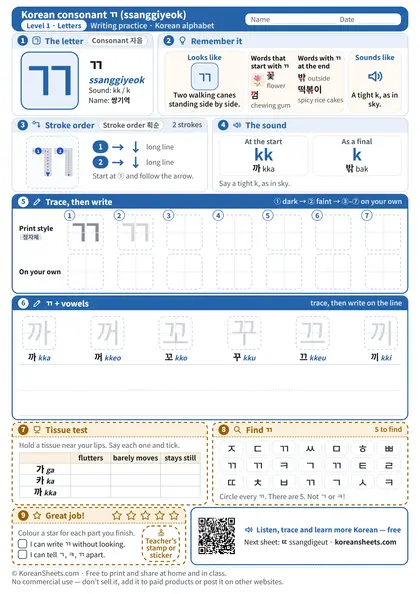
Korean alphabet tracing worksheet: the three g sounds ㄱ ㅋ ㄲ
Hear and write the plain, breathy and tense g side by side.
- 4 pages
- A4 · US Letter
- PDF · 334 KB
- Free · no sign-up
After printing: listen to ㄱ ㅋ ㄲ on the giyeok page
Worksheet information
- For
- Complete beginners of any age
- Inside
- A cover with a tick list, then 3 one-page tracing worksheets for the three g sounds
- How to use
- Do the three pages together. Hold a tissue near your lips and feel the difference between the three sounds.
Pack · Level 1 · Letters
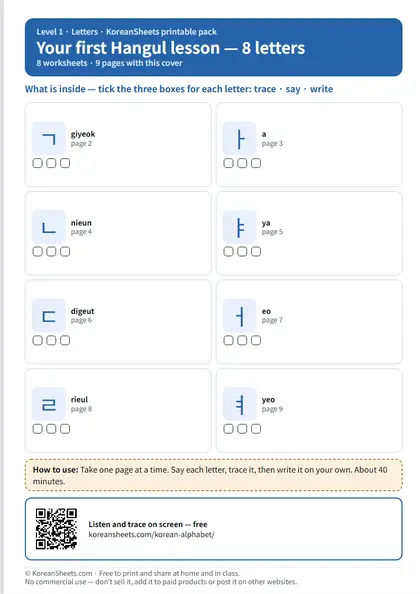
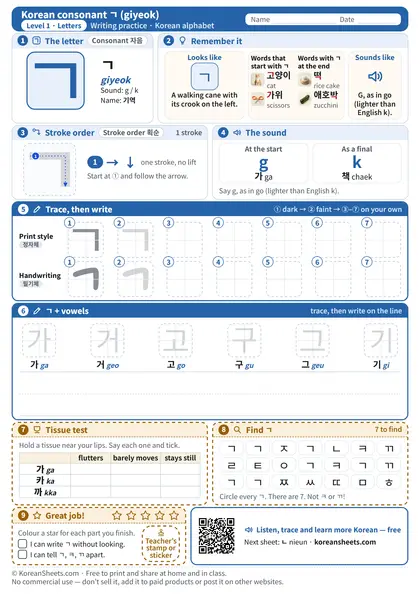
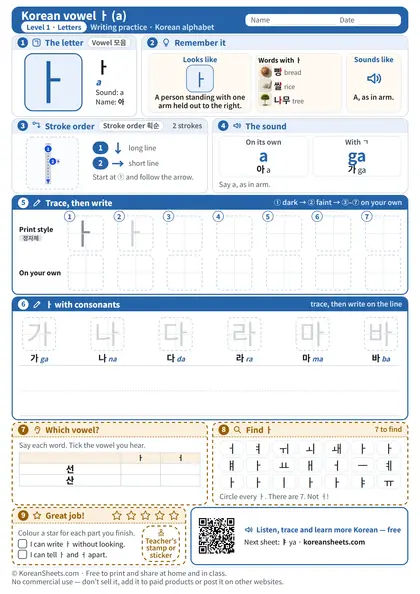
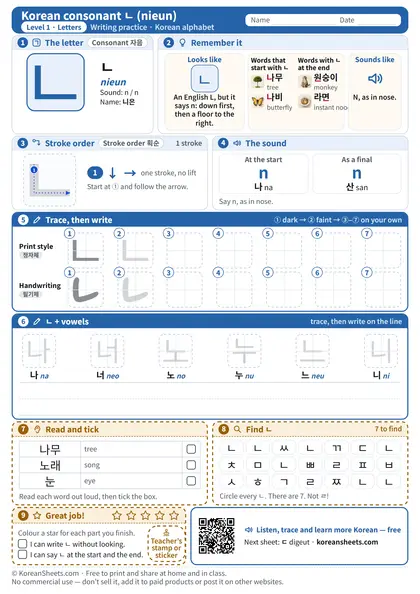
Hangul practice sheets PDF: your first lesson with 8 letters
Four consonants and four vowels in turn: ㄱ ㅏ ㄴ ㅑ ㄷ ㅓ ㄹ ㅕ.
- 9 pages
- A4 · US Letter
- PDF · 710 KB
- Free · no sign-up
After printing: start the eight letters on the Korean alphabet page
Worksheet information
- For
- Complete beginners of any age
- Inside
- A cover with a tick list, then 8 one-page tracing worksheets: stroke order, tracing and a find-the-letter game
- Time
- About 40 minutes
- How to use
- Take one page at a time. Say each letter, trace it, then write it on your own.
Korean letter names
Every Korean consonant has a two-syllable name that spells out the letter itself: the first syllable begins with the letter and the second ends with it, so ㄱ is 기역 and ㄴ is 니은. A vowel's name is simply the vowel written with a silent ㅇ in front, so ㅏ is 아 and ㅗ is 오.
The consonant names in order are 기역, 쌍기역, 니은, 디귿, 쌍디귿, 리을, 미음, 비읍, 쌍비읍, 시옷, 쌍시옷, 이응, 지읒, 쌍지읒, 치읓, 키읔, 티읕, 피읖, and 히읗.
The vowel names in order are 아, 애, 야, 얘, 어, 에, 여, 예, 오, 와, 왜, 외, 요, 우, 워, 웨, 위, 유, 으, 의, and 이.
Korean alphabet order
Within one consonant, blocks are sorted by the vowel and then by the final consonant. That is why 가 comes before 각 and both come before 개.
How Hangul works: letters stacked into syllable blocks
Tall vowel beside the consonant
Tall vowel + batchim
Flat vowel below the consonant
Flat vowel + batchim
Wrapped vowel
Wrapped vowel + batchim
A block always has a first consonant and a vowel, and it may have a final consonant at the bottom. The word 한글 has two blocks: 한 is ㅎ + ㅏ + ㄴ, and 글 is ㄱ + ㅡ + ㄹ.
A vertical vowel such as ㅏ sits to the right of the consonant, a horizontal vowel such as ㅗ sits underneath, and a final consonant goes below both. When a syllable begins with a vowel sound, the silent consonant ㅇ holds the first place, so the sound “a” is written 아.
Counting every legal combination, 19 first consonants, 21 vowels and 28 choices of final (including none) give 11,172 possible blocks.
How to read Korean in three steps
First consonant, then the vowel, then the final consonant if there is one.
Say the blocks one after another, left to right, with a space between words.
Where a final consonant meets the next block, check how the sound links: 책이 is read [채기], not “chaek-i”.
Reading Korean is a matter of three small moves repeated for every word.
About an hour to read Hangul
The five double consonants and the eleven combined vowels, comparing 가 with 까 and 애 with 에.
Building blocks with a final consonant, such as 각, 간 and 감.
The seven final sounds and the linking rule in 책이 and 밖에.
Read real words aloud: 한글 (Hangul), 커피 (coffee), 피자 (pizza), and 책 (book).
Many learners can sound out simple blocks after about an hour of focused practice, though reading quickly takes longer. Here is one way to spend that hour.
Korean alphabet pronunciation
Most Korean consonants come in three strengths. A plain consonant is light, an aspirated one is released with a strong puff of air, and a tense one is tight with no puff at all. English has no such triple, so the difference between 달, 탈 and 딸 is the first thing to train your ear on.
Vowels are steadier than English vowels: each letter has one main sound, and the glides are marked by extra strokes. Final consonants are pronounced as only seven sounds, which is why 꽃 is read [꼳].
Hangul keyboard layout
On a standard Korean keyboard the consonants sit on the left half and the vowels on the right half. A syllable is typed by moving between the two hands, so 한 is typed as a consonant, a vowel and a consonant in that order.
The practice page lets you build blocks by choosing letters instead of typing, which is a gentler way to learn how the blocks fit together.
English sounds in Hangul
Words borrowed from English are written with Hangul letters in a way that follows their sound: 커피 (coffee), 피자 (pizza), 택시 (taxi), 컴퓨터 (computer), and 라디오 (radio).
Who invented Hangul, and Hangul Day
Hangul was created in the fifteenth century under King Sejong the Great and presented to the public in 1446 in a document called Hunminjeongeum, which means “the correct sounds for instructing the people.”
South Korea celebrates the alphabet each year on October 9, called Hangul Day (한글날).
Explore every Korean letter
Each letter has its own page with a stroke-order guide, example words and a free worksheet.
Try it in the syllable builder
Try it yourself

Build a block with the word 한 and see how it is read. Open the syllable builder with the word 한 ready
Korean alphabet FAQ
How many letters in Korean alphabet?
There are 40 letters in the modern Hangul alphabet: 14 basic consonants, 5 double consonants, 10 basic vowels and 11 combined vowels. Counting only the 24 basic letters gives the number most beginners learn first.
How to read Korean?
Read one syllable block at a time: first consonant, vowel, then any final consonant, and join the blocks left to right. Check how a final consonant links to the next block, as in 책이 [채기].
How to read Hangul?
Learn the 24 basic letters first, then practice reading blocks aloud with ㅇ and ㅏ, then add final consonants. The plan above, about an hour for a first pass, shows the order.
Who invented Hangul?
Hangul was created in the fifteenth century under King Sejong the Great and published in 1446. The founding document is called Hunminjeongeum.
Last updated: