
Ieung (ㅇ) – Korean Consonant 이응
ㅇ (Ieung, 이응) is silent at the start of a syllable and an ng sound at the end. See 오리 and 우유 as examples, trace ㅇ in 1 stroke, print the ㅇ worksheet.
What is Ieung (ㅇ) in Korean?
Ieung (ㅇ) is called 이응 in Korean and is silent at the start of a syllable and an ng sound at the end. Write ㅇ in 1 stroke; the sound is made with the throat, and it counts as one of the 14 basic consonants. You can hear it in 오리 (duck) and 우유 (milk), and see it closing a syllable in 공 (ball).
Ieung ㅇ: sound, strokes, series and finals
ㅇ IeungKorean consonant · basic
Ieung is null at the start of a syllable and ng at the end.
Ieung (ㅇ) at a glance
| Fact | Value |
|---|---|
| Name | 이응 (ieung) |
| Sound at the start | silent (the letter holds the place) |
| Sound at the end | ng (unreleased) |
| Strokes | 1 |
| Group | basic consonant |
| Made with | the throat |
| Example words | at the start: 어항 (fish bowl), 여우 (fox); at the end: 빵 (bread), 고양이 (cat) |
Three ways to remember ㅇ
 Shape
 Words that start with ㅇ
 fish bowl
 fox
 duck
 cucumber
Sound: silent.
Words with ㅇ at the end
 bread
 cat
- fish bowl
 monkey
More words with ㅇ
Sound: ng.
How to say ㅇ
이응With ㅇ (ieung), at the start of a syllable ㅇ has no sound at all; the vowel begins directly. At the end of a syllable it is ng, as in English 'sing', with the back of the tongue raised.
Every Korean syllable begins with a consonant letter, so ㅇ fills that spot when the sound starts with a vowel: 아 (a), 우유 (uyu, milk). As a 받침 it is romanized ng, as in 방 (bang, room).
How ㅇ ends a syllable
In 공 (ball) the back of the tongue lifts while the sound hums through the nose, the same ng as in “song”. Unlike most finals, ㅇ does not jump forward before a vowel: 공이 stays [공이].
Unlike most finals, ㅇ (ieung) sounds like itself at the bottom of the block, only shorter and unreleased.
How to write ㅇ
Trace Ieung ㅇ with a finger, mouse or pen: start at the numbered dot, follow the dotted arrow, and press Clear to try again.
Print style 정자체
Follow the numbers and dotted arrows
Handwriting 필기체
Same stroke order as print style
Start at the top and draw a circle counterclockwise, ending where you began.
Count one stroke when you write ㅇ (ieung), always moving from the top and the left.
Draw ㅇ as one smooth circle, starting at the top and moving counterclockwise. In 아 it is a small circle beside the vowel; in 오 it sits on top and can be a little wider.
ㅇ and its look-alikes
| Letter | Name | Sound |
|---|---|---|
| ㅇ | 이응 (ieung) | nothing at the start, ng as in ring at the end |
| ㅎ | 히읗 (hieut) | h, as in hat |
Why ㅇ looks the way it does
ㅇ copies the shape of the throat, and it has no sound as a first consonant. ㅎ was made from it by adding strokes.
ㅇ (ieung) belongs to the group made with the throat, because the original design of Hangul sorted consonants by the part of the mouth that makes them.
Words that use ㅇ
| Word | Reading | Meaning |
|---|---|---|
| 와플 | wa-peul | waffle (noun) |
| 외투 | oe-tu | coat (noun) |
| 요요 | yo-yo | yo-yo (word) |
| 우산 | u-san | umbrella (noun) |
| 짜장면 | jja-jang-myeon | black-bean noodles (noun) |
| 호랑이 | ho-rang-i | tiger (noun) |
| 야구공 | ya-gu-gong | baseball (noun) |
| 공원 | gong-won | park (noun) |
In 오리 (duck), ㅇ holds the silent opening place of the first block 오, which is read o.
In 우유 (milk), ㅇ holds the silent opening place of the first block 우, which is read u.
In 이름 (name), ㅇ holds the silent opening place of the first block 이, which is read i.
In 아기 (baby), ㅇ holds the silent opening place of the first block 아, which is read a.
In 얼굴 (face), ㅇ holds the silent opening place of the first block 얼, which is read eol.
Syllables you can build with ㅇ
Start a block with ㅇ and add a vowel: 아 (a), 야 (ya), 어 (eo), and 여 (yeo), and more.
The ten blocks 아 (a), 야 (ya), 어 (eo), 여 (yeo), 오 (o), 요 (yo), 우 (u), 유 (yu), 으 (eu), 이 (i) are worth reading in one breath.
Try it yourself

Pick a vowel and a final for ㅇ and read the block it makes. Open the syllable builder with ㅇ ready
ㅇ writing worksheet (free printable)
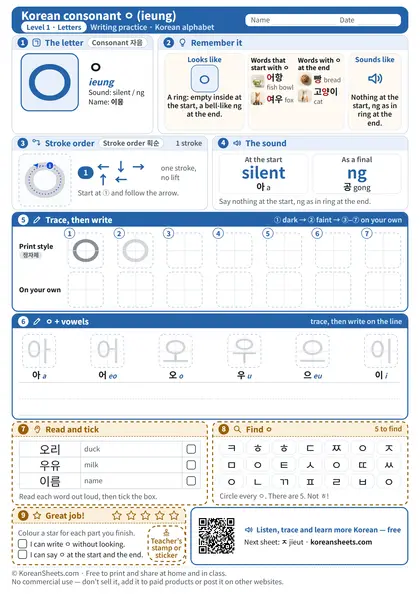
Worksheet · Level 1 · Letters
Korean letter tracing worksheet: ㅇ (ieung)
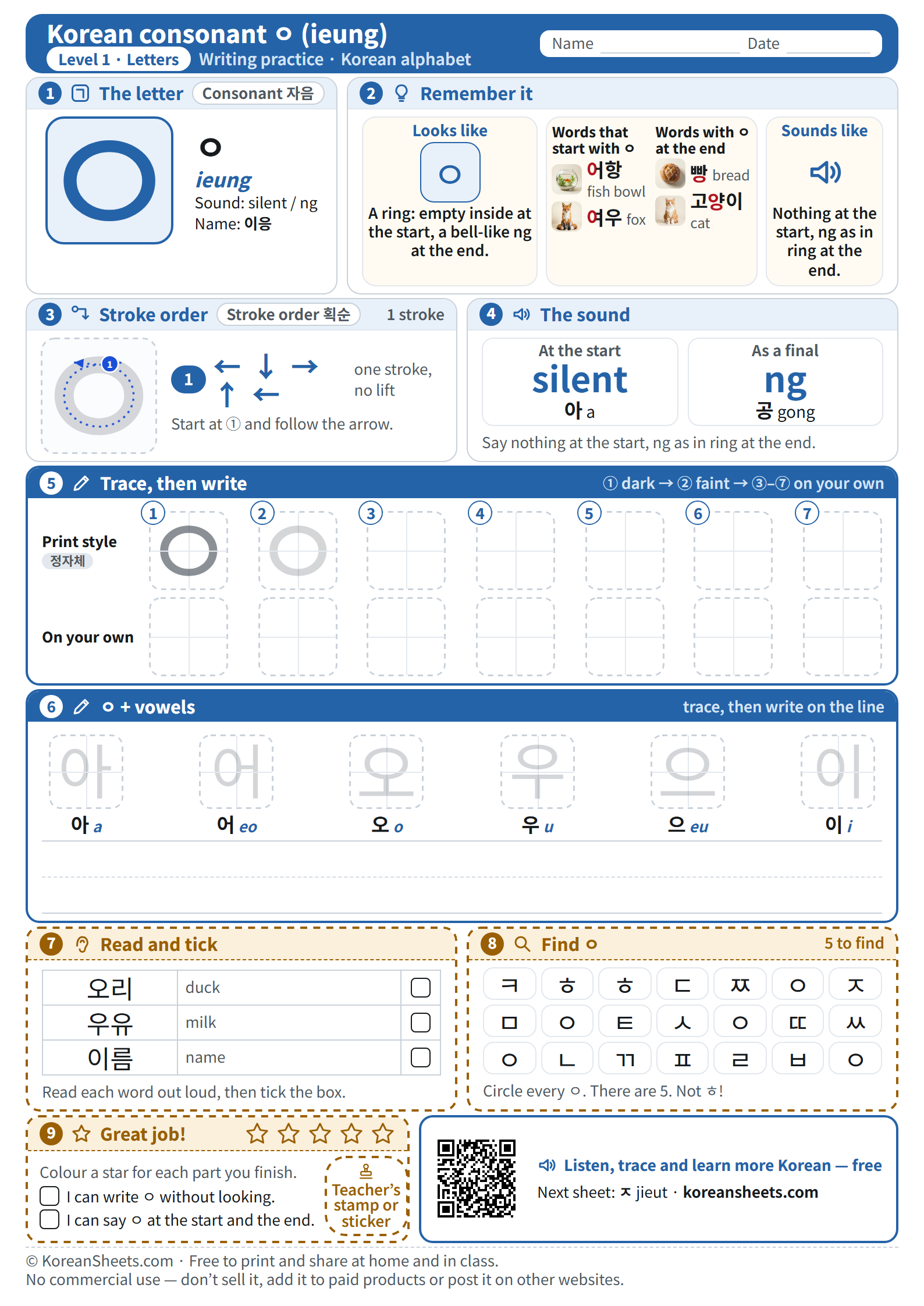
The one-page Ieung ㅇ sheet shows ㅇ in 1 stroke, traces it, writes it with six vowels (아 어 오 우 으 이) and ends with a game of finding ㅇ among look-alikes.
- 1 page
- A4 · US Letter
- PDF · 111 KB
- Free · no sign-up
Want more? Get all 19 consonants in one pack
Worksheet information
- How to use
- Say ㅇ out loud, trace its 1 stroke, then write it with six vowels.
Practice ㅇ
Try it yourself
Put Ieung ㅇ, silent, into the builder and read the block it makes. Open the syllable builder with ㅇ ready
ㅇ (Ieung) — FAQ
What is the ㅇ pronunciation?
The ㅇ pronunciation is silent at the start of a syllable and an ng sound at the end. The sound in 오리 (duck) is the one to copy first.
What is ㅇ called in Korean and what sound does it make?
ㅇ is called 이응 (ieung). It is read silent at the start of a syllable and an ng sound at the end, as in 오리 and 공.
Why does ㅇ have no sound in 아?
In 아 the ㅇ (ieung) is a silent placeholder, because every syllable starts with a consonant letter. At the bottom of a syllable, as in 방, it sounds ng.
How many strokes is ㅇ?
ㅇ has 1 stroke: a circle drawn counterclockwise from the top.
Last updated: