
Ssang Siot (ㅆ) – Korean Consonant 쌍시옷
ㅆ (Ssang Siot, 쌍시옷) is a tight ss that closes a syllable as a short t. See 쌀 and 쓰레기 as example words, trace ㅆ in 4 strokes, print the ㅆ worksheet for free.
What is Ssang Siot (ㅆ) in Korean?
Ssang Siot (ㅆ) is called 쌍시옷 in Korean and is a tight ss that closes a syllable as a short t. ㅆ needs 4 strokes on paper, uses the teeth ridge to make its sound, and is a double consonant, written as ㅅ twice. Words to try first are 쌀 (uncooked rice) and 쓰레기 (trash); for the closing sound, listen to 있다 (to be; to have).
Ssang Siot ㅆ: sound, strokes, series and finals
ㅆ Ssang SiotKorean consonant · double
Ssang Siot is ss at the start of a syllable and t at the end.
Ssang Siot (ㅆ) at a glance
| Fact | Value |
|---|---|
| Name | 쌍시옷 (ssangsiot) |
| Sound at the start | ss — a tight hiss |
| Sound at the end | t (the same as ㄷ) |
| Strokes | 4 |
| Group | double consonant |
| Made with | the teeth ridge |
| Example words | at the start: 쌀 (rice), 쓰레기 (trash); at the end: 있다 (to be) |
Three ways to remember ㅆ
 Shape
 Words that start with ㅆ
 rice
- trash
- seed
- twins
Sound: ss.
Words with ㅆ at the end
- 다to be
Sound: t.
How to say ㅆ
쌍시옷ㅆ is a tense s: push the air through a narrow gap with a tight tongue and throat. It is sharper and longer than ㅅ, with no breathy start.
At the start ㅆ is romanized ss, as in 쌀 (ssal, rice). As a 받침 it stops like a final ㄷ, as in 있다 [읻따]; before a vowel it moves over with its full hiss, as in 있어요 [이써요].
How ㅆ ends a syllable
Final ㅆ (ssangsiot) sounds the same as several other letters, because Korean keeps only one stop of this kind at the end of a block. 있다 (to be; to have) ends in that quiet t, while 있어요 reveals the hidden letter as [이써요].
You see ㅆ (ssangsiot) at the bottom of the block, yet your mouth makes ㄷ (digeut), and that gap explains most reading surprises with ㅆ.
How to write ㅆ
Trace Ssang Siot ㅆ with a finger, mouse or pen: start at the numbered dot, follow the dotted arrow, and press Clear to try again.
Print style 정자체
Follow the numbers and dotted arrows
Handwriting 필기체
Same stroke order as print style
First ㅅ, sweep down to the lower left.
First ㅅ, sweep down to the lower right from the middle.
Second ㅅ, sweep down to the lower left.
Second ㅅ, sweep down to the lower right from the middle.
Write ㅆ (ssangsiot) in four strokes, top first and left first.
You will write ㅆ often as a 받침 in past forms: 갔어요, 먹었어요, 했어요. Practice the two small ㅅ shapes close together so they fit under the vowel.
ㅆ and its look-alikes
| Letter | Name | Sound |
|---|---|---|
| ㅅ | 시옷 (siot) | s, as in shelter |
| ㅆ | 쌍시옷 (ssangsiot) | ss, tight hiss |
살 (flesh) and 쌀 (rice) differ only in ㅅ and ㅆ. For 쌀 the tongue is tighter, the hiss stronger and the vowel starts on a higher pitch.
Learners often say ㅆ as a z or simply a longer s. Tension is the key: start the hiss with a tight tongue and let no voice buzz under it.
Why ㅆ looks the way it does
ㅆ is ㅅ (siot) written twice, standing for the tense sound of ㅅ. It is the most common double consonant at the end of a syllable because of verb forms such as 있다 and 했다.
ㅆ (ssangsiot) sits in the group that uses the teeth ridge, since the inventors of Hangul sorted consonants by where the sound is made.
Words that use ㅆ
| Word | Reading | Meaning |
|---|---|---|
| 쑥 | ssuk | mugwort (noun) |
| 싸다 | ssa-da | to be cheap (verb) |
| 쓰다 | sseu-da | to write (verb) |
The first block of 쌀 (uncooked rice) is 쌀, and it opens with ㅆ: read ssal.
The first block of 쓰레기 (trash) is 쓰, and it opens with ㅆ: read sseu.
The first block of 씨앗 (seed) is 씨, and it opens with ㅆ: read ssi.
The first block of 쌍둥이 (twins) is 쌍, and it opens with ㅆ: read ssang.
The first block of 쑥 (mugwort) is 쑥, and it opens with ㅆ: read ssuk.
Syllables you can build with ㅆ
Pair ㅆ (ssangsiot) with the vowels and you get blocks such as 싸 (ssa), 쌰 (ssya), 써 (sseo), and 쎠 (ssyeo).
Say the whole row, 싸 (ssa), 쌰 (ssya), 써 (sseo), 쎠 (ssyeo), 쏘 (sso), 쑈 (ssyo), 쑤 (ssu), 쓔 (ssyu), 쓰 (sseu), 씨 (ssi), and notice that only the vowel moves.
Try it yourself

Pick a vowel and a final for ㅆ and read the block it makes. Open the syllable builder with ㅆ ready
ㅆ writing worksheet (free printable)
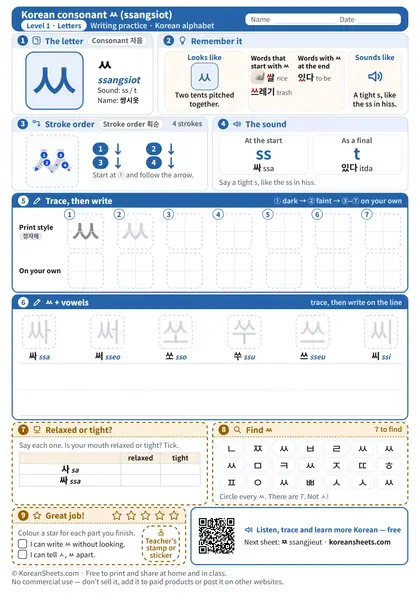
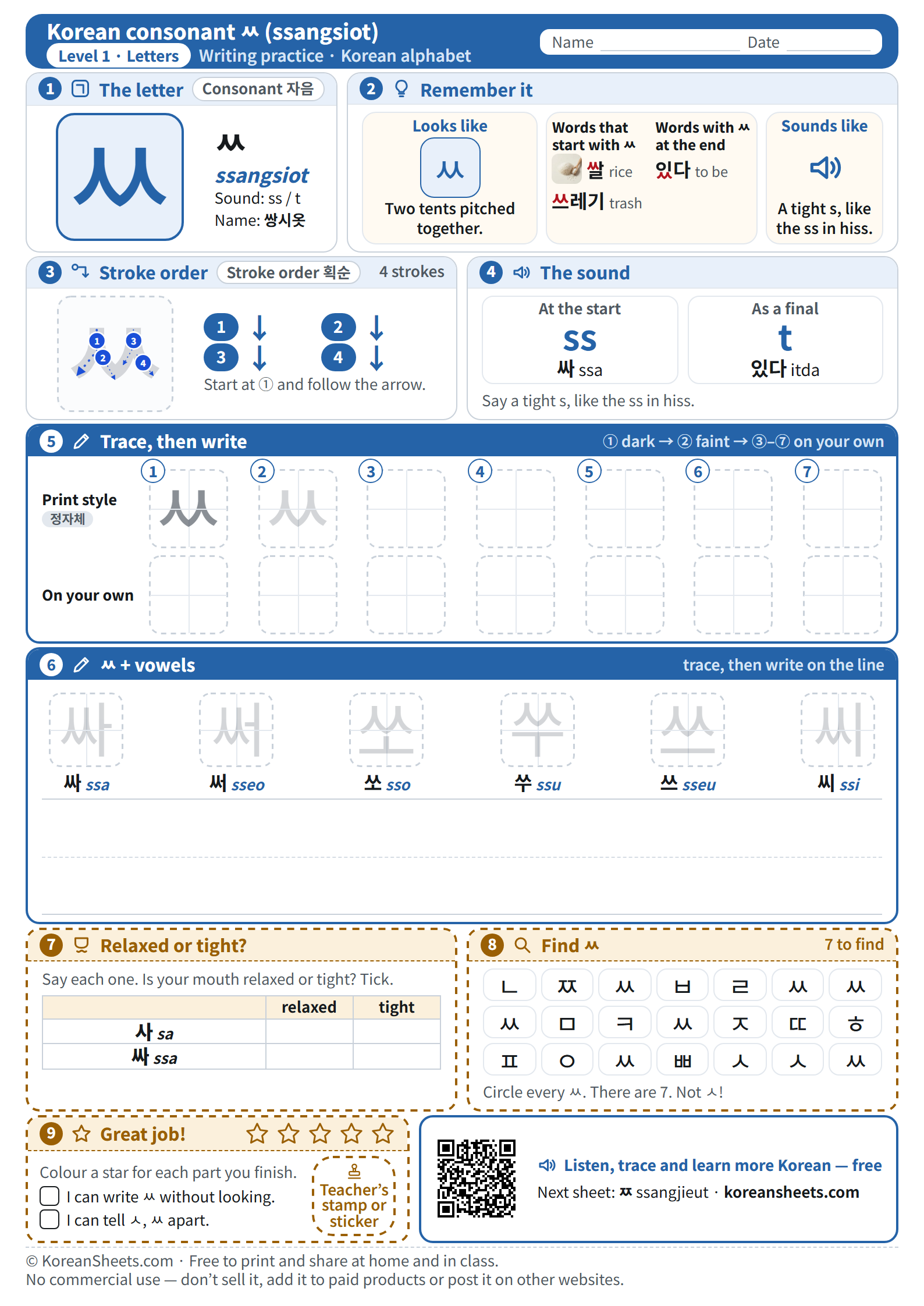
Worksheet · Level 1 · Letters
Korean letter tracing worksheet: ㅆ (ssangsiot)
The one-page Ssang Siot ㅆ sheet shows ㅆ in 4 strokes, traces it, writes it with six vowels (싸 써 쏘 쑤 쓰 씨) and ends with a game of finding ㅆ among look-alikes.
- 1 page
- A4 · US Letter
- PDF · 93 KB
- Free · no sign-up
Want more? Get all 19 consonants in one pack
Worksheet information
- How to use
- Say ㅆ out loud, trace its 4 strokes, then write it with six vowels.
Practice ㅆ
Try it yourself
Put Ssang Siot ㅆ, ss, into the builder and read the block it makes. Open the syllable builder with ㅆ ready
ㅆ (Ssang Siot) — FAQ
What is the ㅆ pronunciation?
The ㅆ pronunciation is a tight ss that closes a syllable as a short t. The sound in 쌀 (uncooked rice) is the one to copy first.
What is the difference between ㅆ and its plain consonant?
ㅆ is the tense partner of ㅅ: it is written as ㅅ twice and read ss with a tight throat and no puff of air, while plain ㅅ is lighter. Compare sa with ssa.
What does ㅆ do at the end of a syllable?
As a 받침, ㅆ (ssangsiot) sounds like a stopped t, as in 있다 [읻따]; before a vowel it moves over with its ss sound, as in 있어요 [이써요].
How many strokes do you need to write ㅆ?
ㅆ has 4 strokes: two for each ㅅ, left one first.
Last updated: