
Bieup (ㅂ) – Korean Consonant 비읍
ㅂ (Bieup, 비읍) is b at the start of a syllable and a short p at the end. See 바나나 and 배 as example words, trace ㅂ in 4 strokes, print the ㅂ worksheet for free.
What is Bieup (ㅂ) in Korean?
Bieup (ㅂ) is called 비읍 in Korean and is b at the start of a syllable and a short p at the end. ㅂ is one of the 14 basic consonants, takes 4 strokes to write and is made with both lips. Words to try first are 바나나 (banana) and 배 (pear; ship; belly); for the closing sound, listen to 집 (house).
Bieup ㅂ: sound, strokes, series and finals
ㅂ BieupKorean consonant · basic
Bieup is b at the start of a syllable and p at the end.
Bieup (ㅂ) at a glance
| Fact | Value |
|---|---|
| Name | 비읍 (bieup) |
| Sound at the start | b — a light breath |
| Sound at the end | p (unreleased) |
| Strokes | 4 |
| Group | basic consonant |
| Made with | both lips |
| Example words | at the start: 바나나 (banana), 바지 (pants); at the end: 컵 (cup), 밥 (cooked rice) |
Three ways to remember ㅂ
 Shape
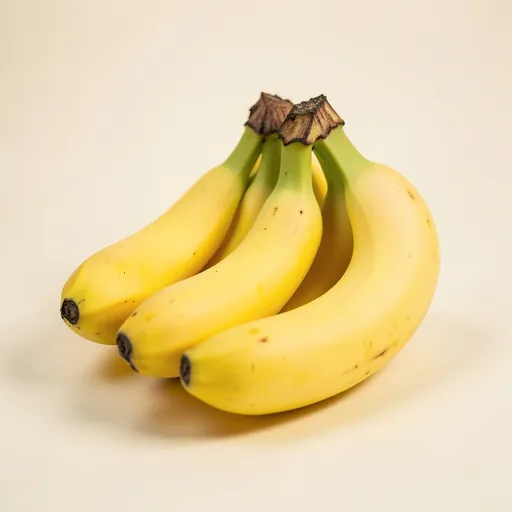
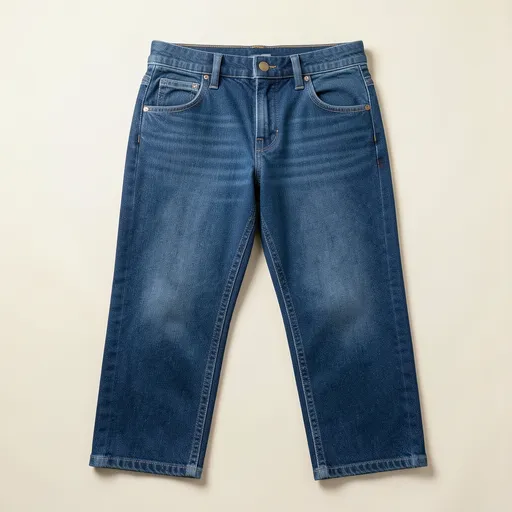
 Words that start with
Words with ㅂ at the end
 cup
- cooked rice
- house
- plate
More words with ㅂ
Sound: p.
How to say ㅂ
비읍Close your lips as for ㅁ but let no air through the nose, then open with a light breath. With ㅂ (bieup), at the start of a word ㅂ sounds between English b and p; between vowels, as in 아버지 (father), it is a soft b.
As a first sound ㅂ is romanized b, as in 밥 (bap, rice). As a 받침 the lips close and stay shut, a short p, which is why the same word ends in p.
How ㅂ ends a syllable
Say 집 (house) and notice that the word ends with your lips together. That closed-lip stop is how ㅂ sounds at the end; with a vowel after it, 집이 becomes [지비].
A final ㅂ (bieup) keeps its own letter in the sound, so spelling and speech agree here; the only change is that the release is held back.
How to write ㅂ
Trace Bieup ㅂ with a finger, mouse or pen: start at the numbered dot, follow the dotted arrow, and press Clear to try again.
Print style 정자체
Follow the numbers and dotted arrows
Handwriting 필기체
Same stroke order as print style
Draw the left vertical line down.
Draw the right vertical line down, parallel to the first.
Draw the middle line across from left to right.
Draw the bottom line across to close the letter.
For ㅂ (bieup), count four strokes when you write ㅂ (bieup), always moving from the top and the left.
Say 밥 slowly: the first ㅂ opens the lips, the last one closes them and stops. Feeling that closing move helps with every final ㅂ, as in 집 (house).
ㅂ and its look-alikes
불 (fire), 풀 (grass) and 뿔 (horn) show the three lip sounds. 불 starts lightly, 풀 with a puff of air, and 뿔 tightly with no puff.
Learners often draw the two horizontal lines first, like a ladder. Write both vertical lines first, then the middle line, then the bottom line.
Why ㅂ looks the way it does
ㅂ uses the same lip shape as ㅁ (mieum) but sounds stronger, so strokes were added to ㅁ. The two tall lines on top are the added strokes.
ㅂ (bieup) belongs to the group made with both lips, because the original design of Hangul sorted consonants by the part of the mouth that makes them.
Words that use ㅂ
| Word | Reading | Meaning |
|---|---|---|
| 배 | bae | pear (noun) |
| 비 | bi | rain (noun) |
| 바다 | ba-da | sea (noun) |
| 웹사이트 | wep-sa-i-teu | website (noun) |
| 지갑 | ji-gap | wallet (noun) |
| 차갑다 | [차갑따] cha-gap-tta | to be cold (adjective) |
In 바나나 (banana), ㅂ (bieup) is the first sound of the first block 바, which is read ba.
In 배 (pear; ship; belly), ㅂ (bieup) is the first sound of the first block 배, which is read bae.
The first block of 비 (rain) is 비, and it opens with ㅂ: read bi.
The first block of 밥 (cooked rice; meal) is 밥, and it opens with ㅂ: read bap.
Look for ㅂ at the front of 바 in 바다 (sea); the block is read ba.
Syllables you can build with ㅂ
With ㅂ (bieup) in front, the vowels give blocks like 바 (ba), 뱌 (bya), 버 (beo), and 벼 (byeo).
The ten blocks 바 (ba), 뱌 (bya), 버 (beo), 벼 (byeo), 보 (bo), 뵤 (byo), 부 (bu), 뷰 (byu), 브 (beu), 비 (bi) are worth reading in one breath.
Try it yourself

Pick a vowel and a final for ㅂ and read the block it makes. Open the syllable builder with ㅂ ready
ㅂ writing worksheet (free printable)
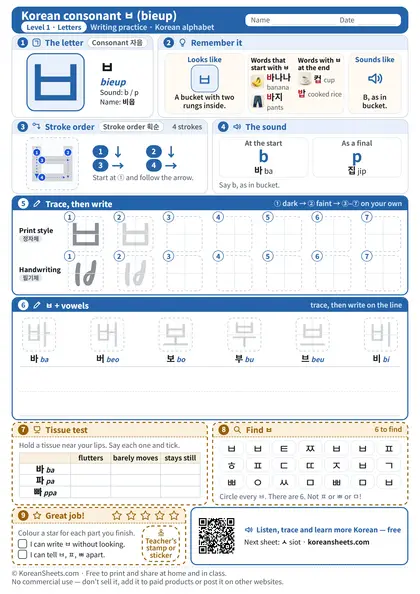
Worksheet · Level 1 · Letters
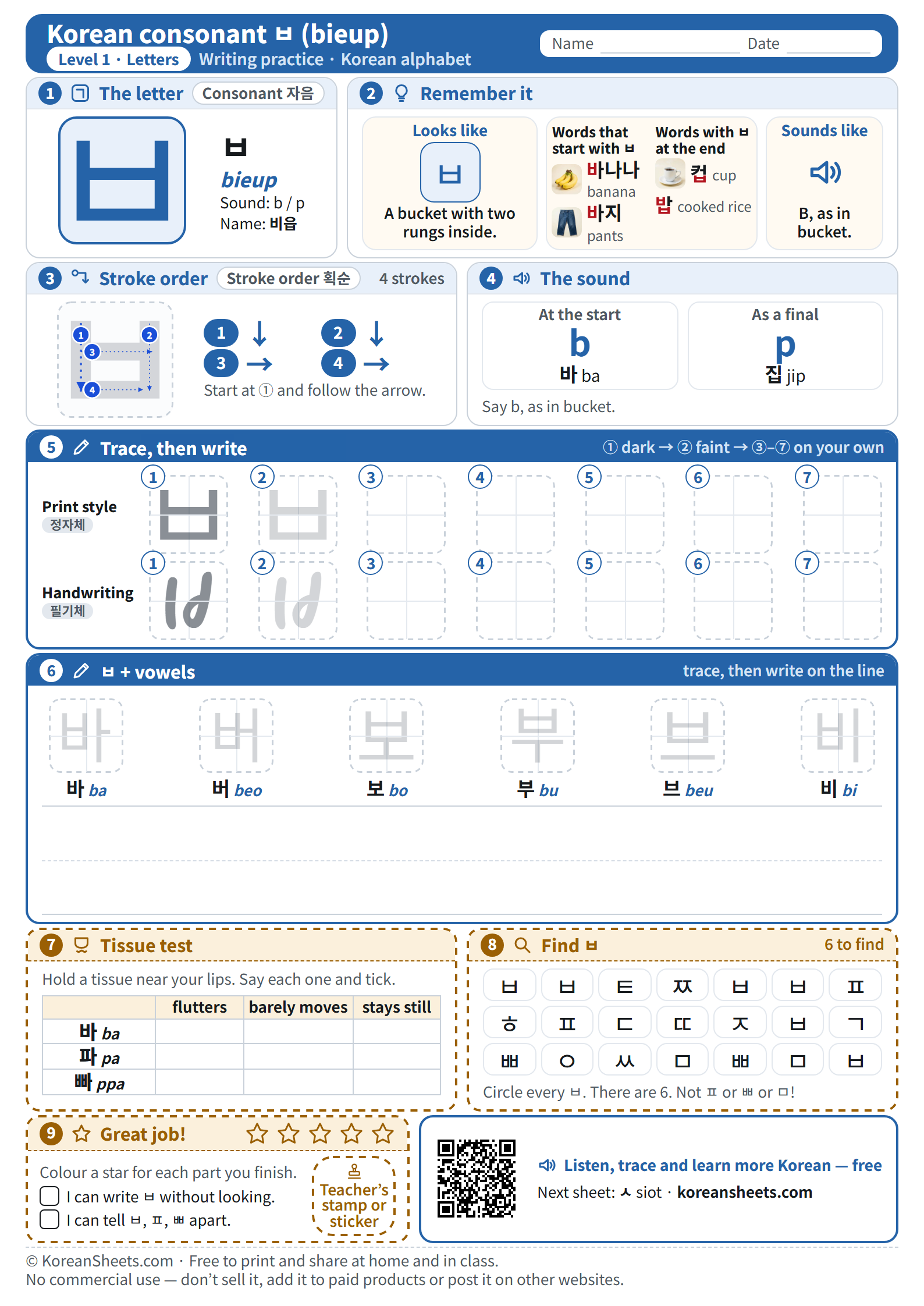
Korean letter tracing worksheet: ㅂ (bieup)
The one-page Bieup ㅂ sheet shows ㅂ in 4 strokes, traces it, writes it with six vowels (바 버 보 부 브 비) and ends with a game of finding ㅂ among look-alikes.
- 1 page
- A4 · US Letter
- PDF · 105 KB
- Free · no sign-up
Want more? Get all 19 consonants in one pack
Worksheet information
- How to use
- Say ㅂ out loud, trace its 4 strokes, then write it with six vowels.
Practice ㅂ
Try it yourself
Put Bieup ㅂ, b, into the builder and read the block it makes. Open the syllable builder with ㅂ ready
ㅂ (Bieup) — FAQ
How would you describe the ㅂ pronunciation?
Read it as b at the start of a syllable and a short p at the end; 바나나 (banana) is a good word to practice with.
ㅂ vs ㅍ: how are they different?
ㅂ is read with a light breath, while ㅍ is read with a strong puff of air. Say 바 (ba) and 파 (pa) in a row to hear it; ㅂ takes 4 strokes and ㅍ takes 4 strokes.
What is ㅂ called in Korean and what sound does it make?
비읍 (bieup) is the name of ㅂ, which is read b at the start of a syllable and a short p at the end; compare 바나나 and 집.
Is ㅂ b or p?
ㅂ (bieup) is written b before a vowel (바 = ba) and p at the end of a syllable (밥 = bap).
How many strokes does ㅂ have?
ㅂ has 4 strokes: left line, right line, middle line, bottom line.
Last updated: