
Tieut (ㅌ) – Korean Consonant 티읕
ㅌ (Tieut, 티읕) is a strongly puffed t that is read as a short t at the end of a syllable. See 토끼 and 택시 as examples, trace ㅌ in 3 strokes, print the ㅌ worksheet.
What is Tieut (ㅌ) in Korean?
Tieut (ㅌ) is called 티읕 in Korean and is a strongly puffed t that is read as a short t at the end of a syllable. ㅌ is one of the 14 basic consonants, takes 3 strokes to write and is made with the tip of the tongue. Words to try first are 토끼 (rabbit) and 택시 (taxi); for the closing sound, listen to 밭 (field).
Tieut ㅌ: sound, strokes, series and finals
ㅌ TieutKorean consonant · basic
Tieut is t at the start of a syllable and the same at the end.
Tieut (ㅌ) at a glance
| Fact | Value |
|---|---|
| Name | 티읕 (tieut) |
| Sound at the start | t — a strong puff of air |
| Sound at the end | t (the same as ㄷ) |
| Strokes | 3 |
| Group | basic consonant |
| Made with | the tip of the tongue |
| Example words | at the start: 타조 (ostrich), 토끼 (rabbit); at the end: 끝 (end), 밭 (field) |
Three ways to remember ㅌ
 Shape
 Words that start with
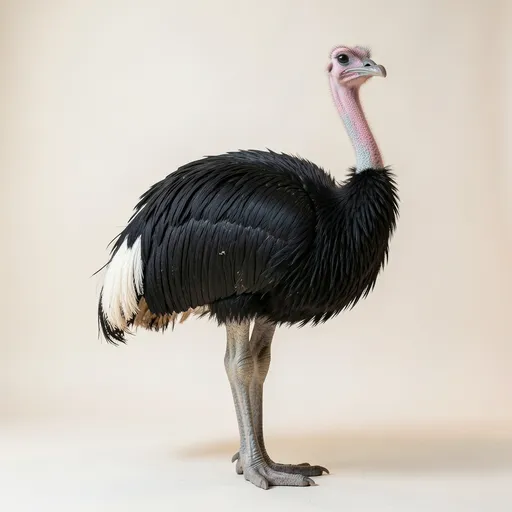

Words with ㅌ at the end
- end
- field
More words with ㅌ
Sound: t.
How to say ㅌ
티읕Make ㄷ with the tongue tip behind the upper teeth and release it with a strong puff of air. ㅌ is close to the t in English 'top'.
At the start ㅌ is romanized t, as in 택시 (taeksi, taxi). As a 받침 it stops like a final ㄷ, so 밭 (field) is [받]; before a vowel the breathy t returns, as in 밭에 [바테].
How ㅌ ends a syllable
In 밭 (field) the tip of the tongue presses behind the upper teeth and holds, so ㅌ is heard as a short t that is never released. Once a vowel follows, as in 밭이, the original letter comes back to life and the word is read [바치].
You see ㅌ (tieut) at the bottom of the block, yet your mouth makes ㄷ (digeut), and that gap explains most reading surprises with ㅌ.
How to write ㅌ
Trace Tieut ㅌ with a finger, mouse or pen: start at the numbered dot, follow the dotted arrow, and press Clear to try again.
Print style 정자체
Follow the numbers and dotted arrows
Handwriting 필기체
Same stroke order as print style
Draw the top line from left to right.
Draw the middle line from left to right, a little shorter.
Start under the left end of the top line, go down, then turn and draw the bottom line to the right.
The whole letter ㅌ (tieut) is three strokes; start high and on the left, as with every Hangul letter.
In 토 (as in 토끼, rabbit) the letter is wide and short because the vowel sits below; in 타 it is tall and narrow. Trace both to feel the change.
ㅌ and its look-alikes
달 (moon), 탈 (mask) and 딸 (daughter) show the ㄷ set. 탈 is the one with a clear puff of air after the tongue lets go.
Learners often draw the left side first and add the lines afterwards, like a capital E. Write the top line, then the middle line, and finish with the ㄴ shape.
Why ㅌ looks the way it does
ㅌ sounds harsher than ㄷ (digeut), so one stroke was added to ㄷ. With ㅌ (tieut), the middle line is that added stroke.
ㅌ (tieut) stands for a sound made with the tip of the tongue, because Hangul's consonant shapes follow the mouth.
Words that use ㅌ
| Word | Reading | Meaning |
|---|---|---|
| 타일 | ta-il | tile (noun) |
| 탁자 | [탁짜] tak-jja | table (noun) |
| 택시 | taek-si | taxi (noun) |
| 트럭 | teu-reok | truck (noun) |
In 토끼 (rabbit), ㅌ (tieut) is the first sound of the first block 토, which is read to.
In 택시 (taxi), ㅌ (tieut) is the first sound of the first block 택, which is read taek.
In 텔레비전 (television), ㅌ (tieut) is the first sound of the first block 텔, which is read tel.
In 티셔츠 (T-shirt), ㅌ (tieut) is the first sound of the first block 티, which is read ti.
Look for ㅌ at the front of 트 in 트럭 (truck); the block is read teu.
Syllables you can build with ㅌ
Blocks that open with ㅌ include 타 (ta), 탸 (tya), 터 (teo), and 텨 (tyeo).
Reading the full row aloud, 타 (ta), 탸 (tya), 터 (teo), 텨 (tyeo), 토 (to), 툐 (tyo), 투 (tu), 튜 (tyu), 트 (teu), 티 (ti), is the quickest way to hear how the vowel changes the block while ㅌ stays put.
Try it yourself

Pick a vowel and a final for ㅌ and read the block it makes. Open the syllable builder with ㅌ ready
ㅌ writing worksheet (free printable)
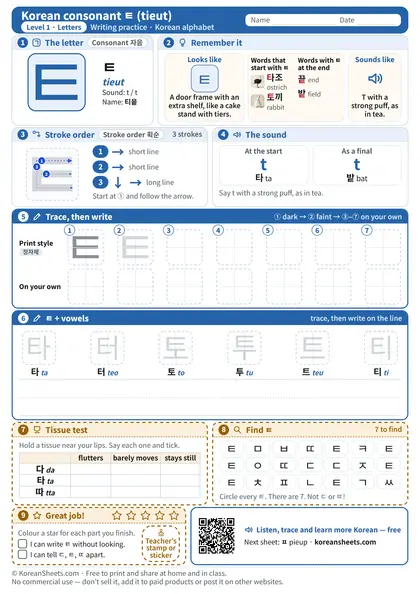
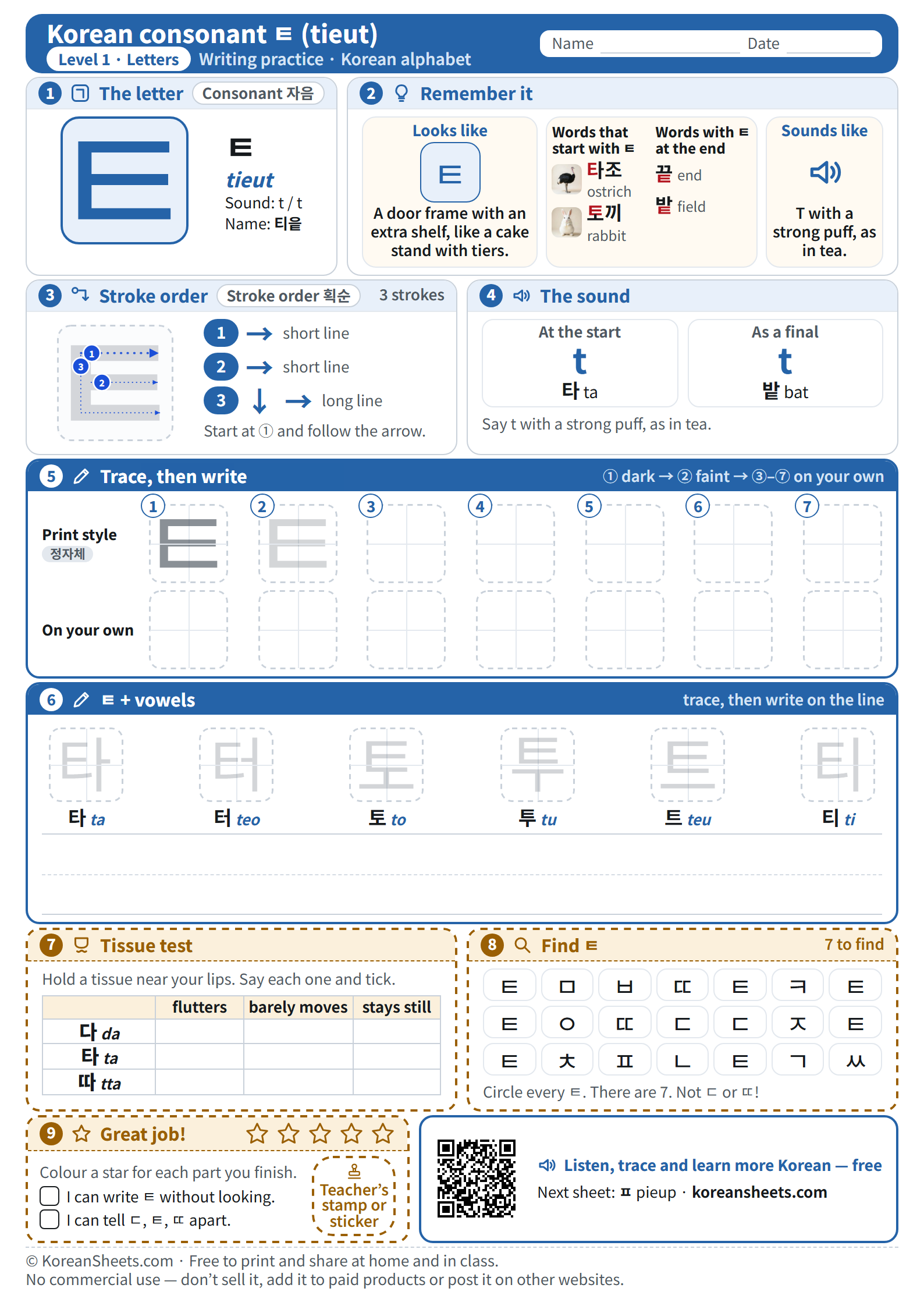
Worksheet · Level 1 · Letters
Korean letter tracing worksheet: ㅌ (tieut)
The one-page Tieut ㅌ sheet shows ㅌ in 3 strokes, traces it, writes it with six vowels (타 터 토 투 트 티) and ends with a game of finding ㅌ among look-alikes.
- 1 page
- A4 · US Letter
- PDF · 95 KB
- Free · no sign-up
Want more? Get all 19 consonants in one pack
Worksheet information
- How to use
- Say ㅌ out loud, trace its 3 strokes, then write it with six vowels.
Practice ㅌ
Try it yourself
Put Tieut ㅌ, t, into the builder and read the block it makes. Open the syllable builder with ㅌ ready
ㅌ (Tieut) — FAQ
Can you explain the ㅌ pronunciation?
The ㅌ pronunciation is a strongly puffed t that is read as a short t at the end of a syllable. The sound in 토끼 (rabbit) is the one to copy first.
What is ㅌ called in Korean and what sound does it make?
ㅌ is called 티읕 (tieut). It is read a strongly puffed t that is read as a short t at the end of a syllable, as in 토끼 and 밭.
How many strokes is ㅌ?
ㅌ (tieut) has 3 strokes: the top line, the middle line, then an ㄴ shape for the left side and bottom.
How do you say ㅌ in Korean?
ㅌ is t with a strong puff of air, as in 택시 (taeksi). At the end of a syllable it is a stopped t: 밭 [받].
Last updated: