
Ga in Korean: the Syllable 가
가 is a Korean syllable block read ga, built from ㄱ + ㅏ. See 가위 and 가방 as examples, trace 가 in 3 strokes, print the 가 worksheet for free.
How do you read and write Ga in Korean (가)?
Ga in Korean is written 가 and is built from ㄱ + ㅏ, a side-by-side block of 3 strokes. 가 is romanized ga. Listen for it first in 가위 (scissors) and 가방 (bag).
Ga in Korean 가: reading, parts and strokes
가 Ga in KoreanKorean syllable block
가 is read ga: ㄱ + ㅏ.
가 at a glance
Two ways to remember 가
 Look
 Words with 가
 scissors
- bag
- shop
- singer
Sound: ga.
How the block 가 is built
Tall vowel beside the consonant
Tall vowel + batchim
Flat vowel below the consonant
Flat vowel + batchim
Wrapped vowel
Wrapped vowel + batchim
With 가 (ga), two letters share the square in 가: ㄱ to the left, ㅏ to the right.
Because ㅏ is tall, ㄱ becomes narrow and its downstroke slants toward the lower left instead of dropping straight.
In the case of 가 (ga), nothing sits at the bottom of this block yet. For 가 (ga), put a consonant there and you get 각 (gak), 간 (gan), 갈 (gal) and the rest of the family.
How to read 가
가가 is romanized ga. At the start of a word it sounds between ga and ka with very little breath, as in 가방 (bag); between vowels it is a clear ga, as in 이야기가.
With 가 (ga), say the consonant, then slide into the vowel: ㄱ then ㅏ makes ga.
Keep the g light and let the breath come out softly with the vowel; if you push a hard puff, a Korean listener hears 카 instead.
How to write 가 stroke by stroke
Trace Ga in Korean 가 with a finger, mouse or pen: start at the numbered dot, follow the dotted arrow, and press Clear to try again.
Print style 정자체
Follow the numbers and dotted arrows
Handwriting 필기체
Same stroke order as print style
Start at the top left, draw a horizontal line to the right, then turn sharply and go straight down.
Finish with ㅏ (a) beside it: draw one tall line down, then a short arm halfway along it.
The block needs three strokes in all, 1 for ㄱ and 2 for ㅏ.
Write 가 inside a square box: ㄱ in the left half, ㅏ in the right half, both starting near the top. Then write 가방 and 가족 to use it in words.
A common slip with 가
Learners often write ㄱ with a square corner and a straight drop, the shape it has in 고. In 가 the downstroke leans left so the block looks balanced.
How 가 is used
가 does a second job as a particle: after a noun that ends in a vowel it marks the subject, so 나비가 means “the butterfly” as the doer of a sentence.
The opening consonant of this block is made with the back of the tongue, and its sound is like g, as in go (lighter than English k).
가 with a final consonant
| Block | Reading | Final |
|---|---|---|
| 각 | gak | ㄱ = k |
| 간 | gan | ㄴ = n |
| 갈 | gal | ㄹ = l |
| 감 | gam | ㅁ = m |
| 갑 | gap | ㅂ = p |
| 강 | gang | ㅇ = ng |
For 가 (ga), six common endings turn this block into 각 (gak), 간 (gan), 갈 (gal), 감 (gam), 갑 (gap), 강 (gang).
In the case of 가 (ga), the endings reduce to these sounds: ㄱ = k, ㄴ = n, ㄹ = l, ㅁ = m, ㅂ = p, ㅇ = ng.
Add ㄱ under 가 and you get 각 (gak), closing on a quiet k. Add ㄴ under 가 and you get 간 (gan), closing on a hummed n. Add ㄹ under 가 and you get 갈 (gal), closing on a tongue-tip l.
Add ㅁ under 가 and you get 감 (gam), closing on a lip-closed m. Add ㅂ under 가 and you get 갑 (gap), closing on a lip-closed p. Add ㅇ under 가 and you get 강 (gang), closing on the ng of song.
ㄱ with other vowels
Keep ㄱ (giyeok) and swap the vowel to get 가 (ga), 거 (geo), 고 (go), 구 (gu), 그 (geu), 기 (gi).
가 next to 하 and 나
On the other side, 하 (ha) is made with the throat and gives a breathy h, which you can compare with 가.
Words that start with 가
| Word | Reading | Meaning |
|---|---|---|
| 가을 | ga-eul | autumn (noun) |
| 가족 | ga-jok | family (noun) |
| 가엾다 | [가엽따] ga-yeop-tta | to be pitiful (adjective) |
가위 (scissors) begins with the block 가 and is read ga-wi.
가방 (bag) begins with the block 가 and is read ga-bang.
가족 (family) begins with the block 가 and is read ga-jok.
가수 (singer) begins with the block 가 and is read ga-su.
가을 (autumn) begins with the block 가 and is read ga-eul.
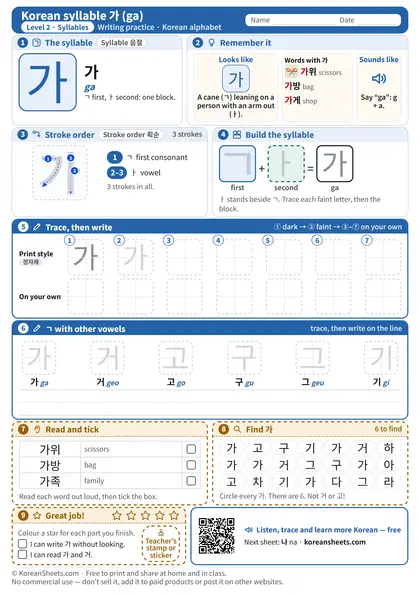
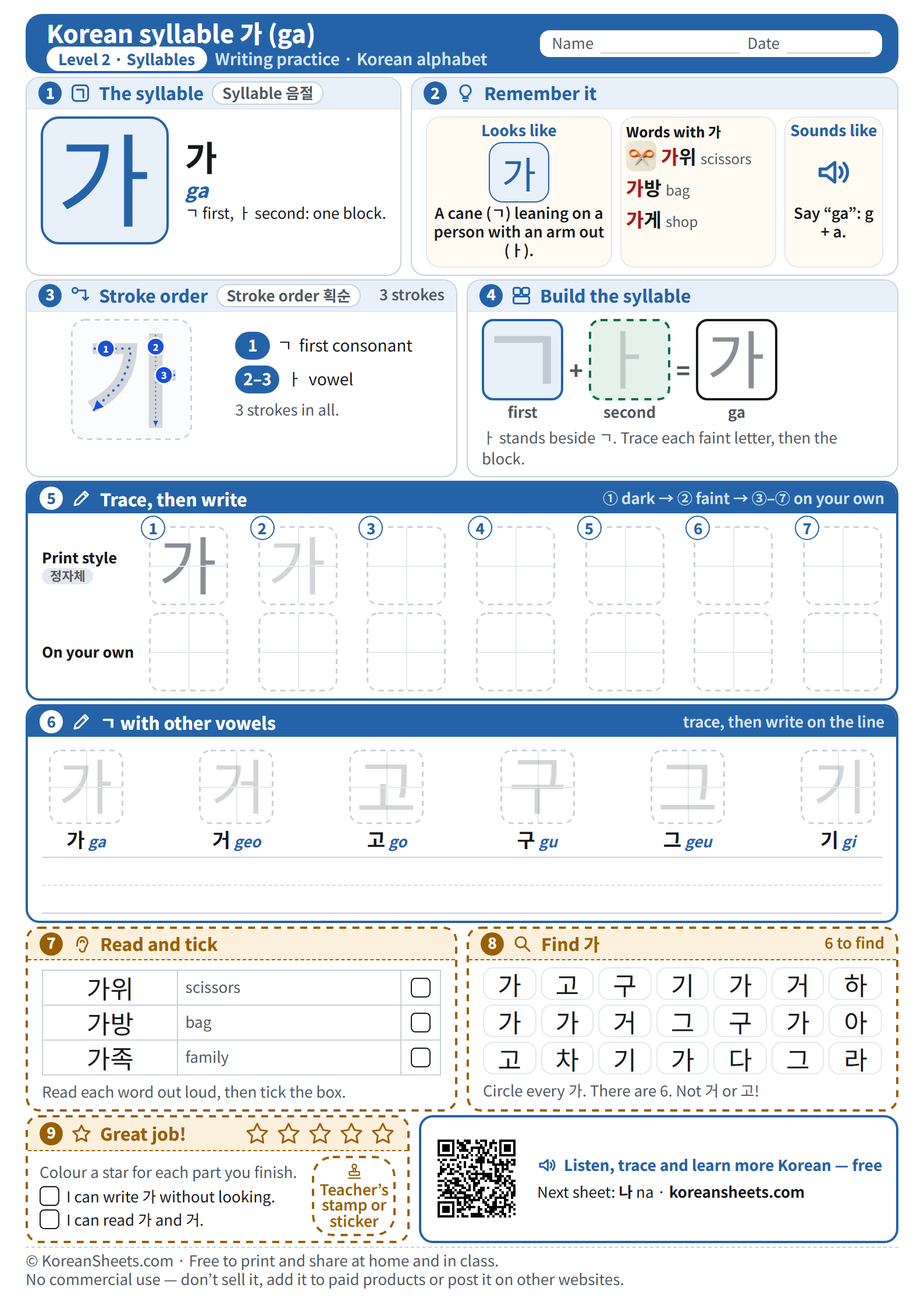
가 writing worksheet (free printable)
Worksheet · Level 1 · Letters
Korean syllable tracing worksheet: 가 (ga)
The one-page Ga in Korean 가 sheet builds 가 (ga) from ㄱ + ㅏ, traces it, writes ㄱ with other vowels (가 거 고 구 그 기) and ends with a game of finding 가.
- 1 page
- A4 · US Letter
- PDF · 91 KB
- Free · no sign-up
Want more? Get a printable pack of Hangul letters
Worksheet information
- How to use
- Build 가 from ㄱ + ㅏ, trace it, then write it on your own.
Practice 가
Try it yourself

Put Ga in Korean 가, ga, into the builder and read the block it makes. Open the syllable builder with 가 ready
가 (Ga in Korean) — FAQ
How do you read 가?
Read 가 as ga, with ㄱ first and ㅏ after it. 가 is romanized ga.
Which letters make up 가?
The letters inside 가 are ㄱ and ㅏ, with ㄱ on the left and ㅏ on the right.
How do you write 가 stroke by stroke?
The block is 3 strokes, drawn in the order ㄱ then ㅏ; ㄱ uses 1 and ㅏ uses 2.
How is 가 made?
가 is ㄱ (g) + ㅏ (a), written side by side: ㄱ on the left, ㅏ on the right. It is romanized ga.
Last updated: