
Ssang Giyeok (ㄲ) – Korean Consonant 쌍기역
ㄲ (Ssang Giyeok, 쌍기역) is a tight kk that closes a syllable as a short k. See 꽃 and 꿈 as example words, trace ㄲ in 2 strokes, print the ㄲ worksheet for free.
What is Ssang Giyeok (ㄲ) in Korean?
Ssang Giyeok (ㄲ) is called 쌍기역 in Korean and is a tight kk that closes a syllable as a short k. ㄲ (ssanggiyeok) is a double consonant, written as ㄱ twice, takes 2 strokes to write and is made with the back of the tongue. You can hear it in 꽃 (flower) and 꿈 (dream), and see it closing a syllable in 밖 (outside).
Ssang Giyeok ㄲ: sound, strokes, series and finals
ㄲ Ssang GiyeokKorean consonant · double
Ssang Giyeok is kk at the start of a syllable and k at the end.
Ssang Giyeok (ㄲ) at a glance
| Fact | Value |
|---|---|
| Name | 쌍기역 (ssanggiyeok) |
| Sound at the start | kk — a tight throat and no puff of air |
| Sound at the end | k (the same as ㄱ) |
| Strokes | 2 |
| Group | double consonant |
| Made with | the back of the tongue |
| Example words | at the start: 꽃 (flower), 껌 (chewing gum); at the end: 밖 (outside), 떡볶이 (spicy rice cakes) |
Three ways to remember ㄲ
 Shape
 Words that start with ㄲ
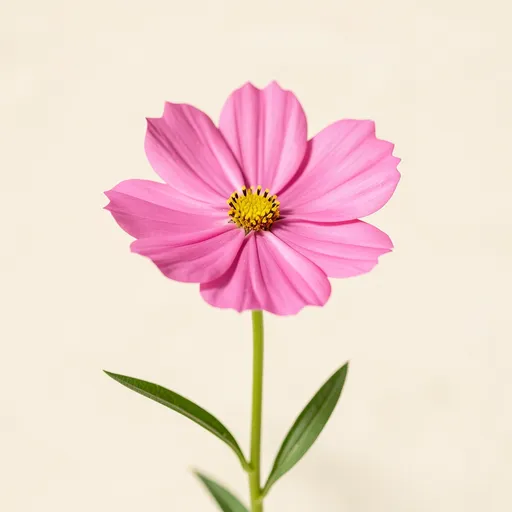 flower
- chewing gum
- dream
- end
Sound: kk.
Words with ㄲ at the end
- outside
- spicy rice cakes
More words with ㄲ
Sound: k.
How to say ㄲ
쌍기역ㄲ is a tense k: tighten your throat and tongue, hold the closure a moment, and release with no puff of air. It is close to the k in English 'ski', which has no breath after it.
With ㄲ (ssanggiyeok), at the start of a syllable ㄲ is romanized kk, as in 꽃 (kkot, flower). It can also be a 받침, as in 밖 (outside); there it stops like a plain final ㄱ and sounds k.
How ㄲ ends a syllable
Say 밖 (outside) slowly and stop at the very end: nothing escapes from the back of your mouth, which is the whole sound of a final ㄲ. The release only returns when a vowel is attached, so 밖에 becomes [바께].
Spelling keeps ㄲ (ssanggiyeok) even though the ending is heard as ㄱ, so reading means turning ㄲ into the sound you hear.
How to write ㄲ
Trace Ssang Giyeok ㄲ with a finger, mouse or pen: start at the numbered dot, follow the dotted arrow, and press Clear to try again.
Print style 정자체
Follow the numbers and dotted arrows
Handwriting 필기체
Same stroke order as print style
Write a narrow ㄱ on the left half: across to the right, then down.
Write a second ㄱ on the right half in the same way, a little taller than the first.
The whole letter ㄲ (ssanggiyeok) is two strokes; start high and on the left, as with every Hangul letter.
Start from words you may already know: 꽃 (flower), 꿈 (dream) and 끝 (end). Say them with a short pause before the vowel, like a small hiccup, and the tense sound comes out.
ㄲ and its look-alikes
Say 기 (gi), 키 (ki) and 끼 (kki). 끼 starts with a tight catch and a higher pitch, while 키 carries a strong breath. If your hand in front of your mouth feels air, it is not ㄲ yet.
Learners often make the two halves of ㄲ full size, so the letter runs into the vowel. Each ㄱ takes only half the width of a single ㄱ.
Why ㄲ looks the way it does
ㄲ (ssanggiyeok) belongs to the group made with the back of the tongue, because the original design of Hangul sorted consonants by the part of the mouth that makes them.
Words that use ㄲ
| Word | Reading | Meaning |
|---|---|---|
| 꼬리 | kko-ri | tail (noun) |
| 까치 | kka-chi | magpie (noun) |
| 꽤 | kkwae | quite (adverb) |
| 꿀 | kkul | honey (noun) |
In 꽃 (flower), ㄲ (ssanggiyeok) is the first sound of the first block 꽃, which is read kkot.
In 꿈 (dream), ㄲ (ssanggiyeok) is the first sound of the first block 꿈, which is read kkum.
In 끝 (end), ㄲ (ssanggiyeok) is the first sound of the first block 끝, which is read kkeut.
In 꼬리 (tail), ㄲ (ssanggiyeok) is the first sound of the first block 꼬, which is read kko.
In 껌 (chewing gum), ㄲ (ssanggiyeok) is the first sound of the first block 껌, which is read kkeom.
Syllables you can build with ㄲ
Blocks that open with ㄲ include 까 (kka), 꺄 (kkya), 꺼 (kkeo), and 껴 (kkyeo).
Reading the full row aloud, 까 (kka), 꺄 (kkya), 꺼 (kkeo), 껴 (kkyeo), 꼬 (kko), 꾜 (kkyo), 꾸 (kku), 뀨 (kkyu), 끄 (kkeu), 끼 (kki), is the quickest way to hear how the vowel changes the block while ㄲ stays put.
Try it yourself

Pick a vowel and a final for ㄲ and read the block it makes. Open the syllable builder with ㄲ ready
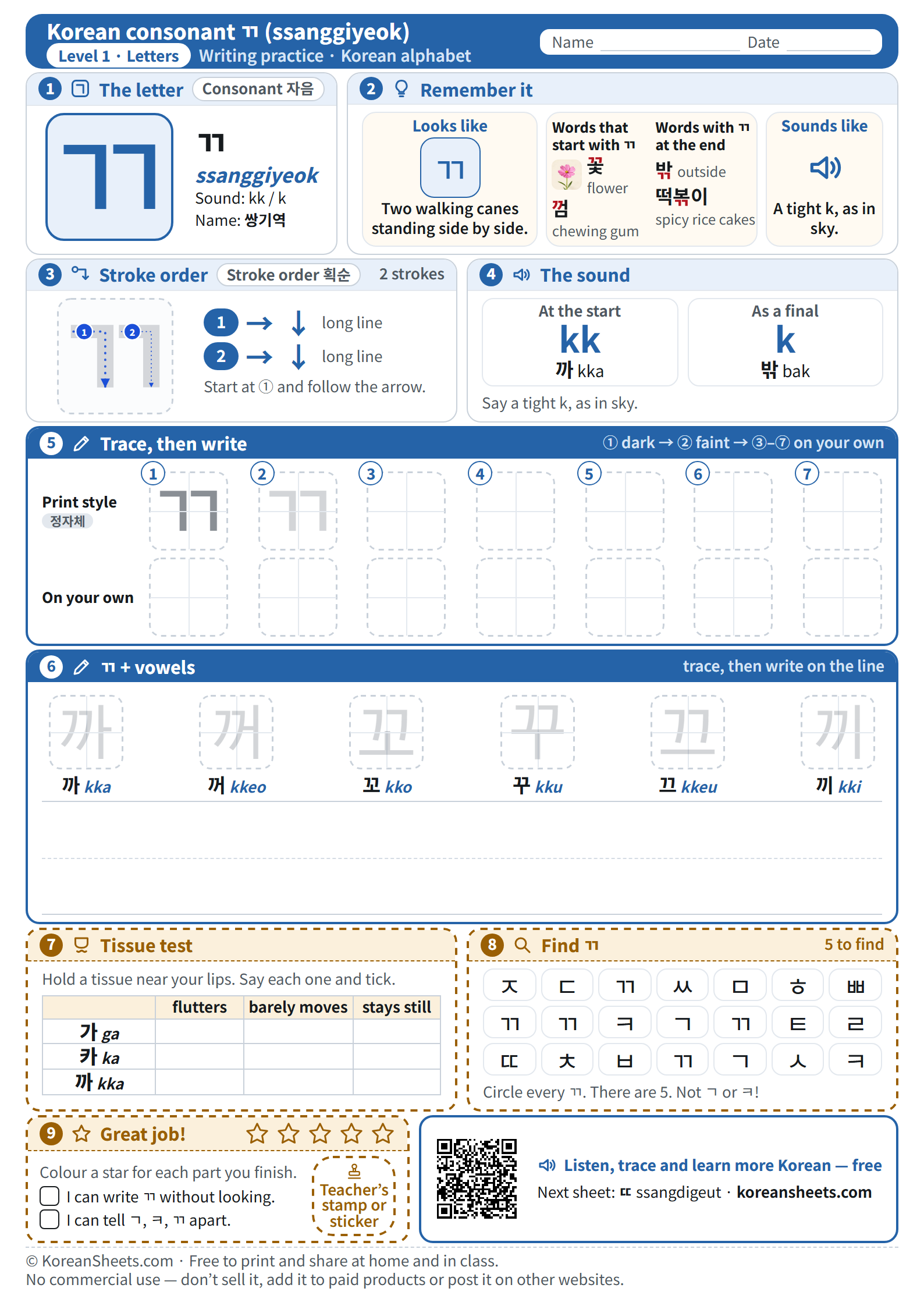
ㄲ writing worksheet (free printable)
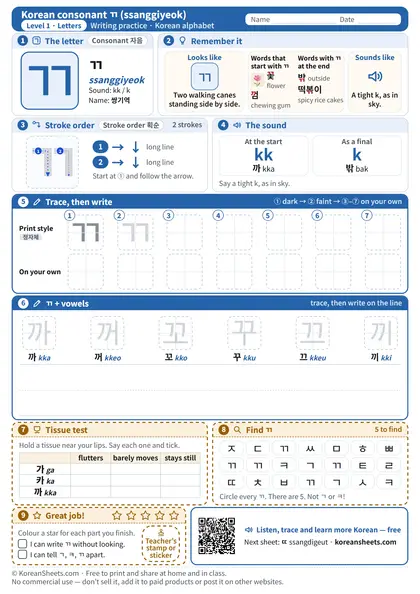
Worksheet · Level 1 · Letters
Korean letter tracing worksheet: ㄲ (ssanggiyeok)
The one-page Ssang Giyeok ㄲ sheet shows ㄲ in 2 strokes, traces it, writes it with six vowels (까 꺼 꼬 꾸 끄 끼) and ends with a game of finding ㄲ among look-alikes.
- 1 page
- A4 · US Letter
- PDF · 91 KB
- Free · no sign-up
Want more? Get all 19 consonants in one pack
Worksheet information
- How to use
- Say ㄲ out loud, trace its 2 strokes, then write it with six vowels.
Practice ㄲ
Try it yourself
Put Ssang Giyeok ㄲ, kk, into the builder and read the block it makes. Open the syllable builder with ㄲ ready
ㄲ (Ssang Giyeok) — FAQ
How would you describe the ㄲ pronunciation?
Read it as a tight kk that closes a syllable as a short k; 꽃 (flower) is a good word to practice with.
What is the difference between ㄲ and its plain consonant?
ㄲ is the tense partner of ㄱ: it is written as ㄱ twice and read kk with a tight throat and no puff of air, while plain ㄱ is lighter. Compare ga with kka.
How many strokes do you need to write ㄲ?
ㄲ has 2 strokes: one narrow ㄱ on the left and a second ㄱ on the right.
Last updated: