
ㄺ (리을기역): the Korean double final consonant
ㄺ joins ㄹ and ㄱ under a vowel. Learn which letter is heard. Hear 닭 alone as 닥 and linked as 달기; print the free ㄺ worksheet.
What sound does ㄺ make at the end of a syllable?
ㄺ (rieul giyeok) is a double final consonant made of ㄹ and ㄱ (giyeok), and at the end of a syllable only the last letter, ㄱ, is heard as a short k. ㄺ is one of the more useful double finals: 닭 (chicken), 읽다 (to read), 맑다 (clear) and 흙 (soil) are all everyday words. A good word to start with is 닭 (chicken): alone it is read [닥 (dak)], and with a vowel ending 닭이 it is read [달기].
ㄺ rieul giyeok: parts, sound and strokes
ㄺ 리을기역Korean double final consonant
ㄺ joins ㄹ and ㄱ; at the end of a syllable the last letter, ㄱ, is heard.
ㄺ at a glance
Which sound ㄺ makes at the end
리을기역ㄺ before a vowel
| Word | Alone | Linked |
|---|---|---|
| 닭 (chicken) | [닥] | 닭이 [달기] |
| 읽다 (to read) | [익따] | 읽어요 [일거요] |
| 맑다 (to be clear) | [막따] | 맑은 [말근] |
| 흙 (soil) | [흑] | 흙이 [흘기] |
Before a vowel both letters appear: the ㄹ ends the first syllable and the ㄱ moves to the next. 닭이 is [달기], 읽어요 is [일거요] and 흙이 is [흘기].
Say 닭 (chicken) on its own first, as [닥], and then 닭이, which is read [달기]. Say 읽다 (to read) on its own first, as [익따], and then 읽어요, which is read [일거요]. Say 맑다 (to be clear) on its own first, as [막따], and then 맑은, which is read [말근]. Say 흙 (soil) on its own first, as [흑], and then 흙이, which is read [흘기].
More forms of ㄺ to listen for
| Form | Reading |
|---|---|
| 읽고 | [일꼬] |
| 읽지 | [익찌] |
| 읽는 | [잉는] |
| 읽은 | [일근] |
In verbs, ㄺ before ㄱ is read as ㄹ, before other consonants as ㄱ, and before a vowel both letters return.
Forms worth repeating are 읽고 [일꼬], 읽지 [익찌], 읽는 [잉는], 읽은 [일근]; the written letters are the same, but the sounds shift around them.
Think of ㄺ as a door with two handles: 닭 uses the last one, and 읽고 uses the first.
Exceptions and special cases for ㄺ
A common slip with ㄺ
Learn two anchor words, 닭 [닥] for the end-of-word sound and 읽고 [일꼬] for the exception. Most other cases fall into one of these two patterns.
How to write ㄺ
Trace rieul giyeok ㄺ with a finger, mouse or pen: start at the numbered dot, follow the dotted arrow, and press Clear to try again.
Print style 정자체
Follow the numbers and dotted arrows
Handwriting 필기체
Same stroke order as print style
The two letters inside ㄺ
Where ㄺ sits in a block
Words that use ㄺ
 Words with ㄺ
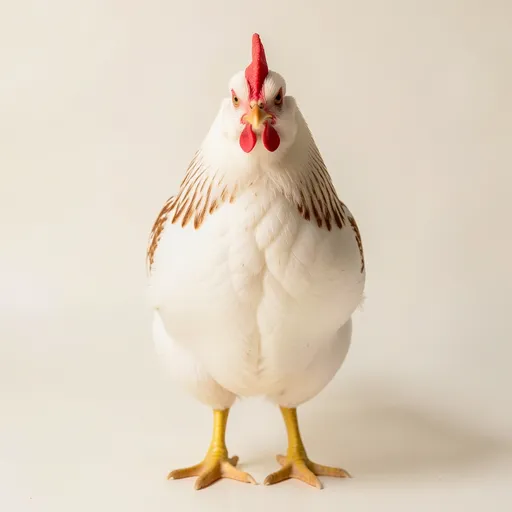
| Word | Reading | Meaning |
|---|---|---|
| 밝다 | [박따] bak-tta | to be bright (verb) |
| 읽다 | [익따] ik-tta | to read (verb) |
Each word here uses ㄺ (rieul-giyeok) as its final; the table lists the reading and the meaning.
ㄺ among the other double finals
ㄺ writing worksheet (free printable)
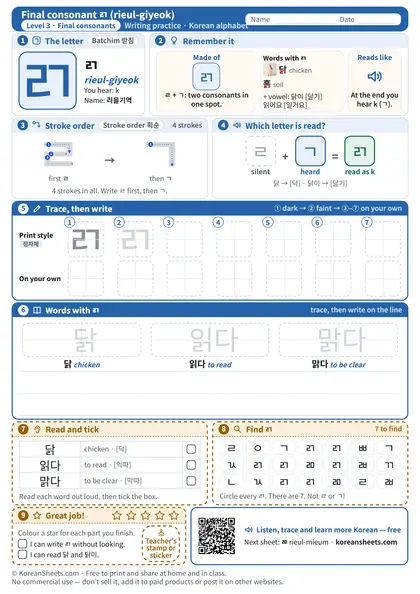
Worksheet · Level 1 · Letters
Korean double final consonant tracing worksheet: ㄺ (rieul giyeok)
The one-page rieul giyeok ㄺ sheet shows which of ㄹ and ㄱ is read, traces ㄺ, and practises the words 닭, 읽다, 맑다.
- 1 page
- A4 · US Letter
- PDF · 88 KB
- Free · no sign-up
Want more? Get a printable pack of Hangul letters
Worksheet information
- How to use
- Decide which letter of ㄺ you hear, trace it in 4 strokes, then practice 닭 and 읽다.
Practice ㄺ
Practice the pair [닥] and [달기] aloud, bare form first and the vowel form second.
Print the ㄺ (rieul-giyeok) worksheet when you are ready: one page, built from the facts above, with the strokes to trace and a letter-spotting game.
Try it yourself

Put rieul giyeok ㄺ, k, into the builder and read the block it makes. Open the syllable builder with ㄺ ready
-
rieul mieum
ㄻ
Next double final — sounds [ㅁ]
-
rieul
ㄹ
Left part — silent at the end of a syllable (exception: before ㄱ in a verb stem this part is the one you hear — 맑게 → [말께])
-
giyeok
ㄱ
Right part — this is the sound you hear: [k] (exception: before ㄱ in a verb stem it is read [l] — 맑게 → [말께])
-
Batchim rules
27
How each final sounds
ㄺ (리을기역) — FAQ
Which sound does ㄺ make when it ends a syllable?
Only ㄱ is heard, as a short k.
When is ㄺ read with both letters?
Before a vowel both letters appear. Examples: the ㄹ ends the first syllable and the ㄱ moves to the next.
Why is 읽고 read [일꼬] and not [익꼬]?
In a verb stem, ㄺ before ㄱ is read with the ㄹ sound, and the following ㄱ becomes tense. That is why 읽고 is [일꼬] and 맑게 is [말께], while the noun 닭 is [닥].
How many strokes does ㄺ have?
ㄺ has four strokes: ㄹ takes 3 strokes and ㄱ takes 1 stroke.
Last updated: