
ㄽ (리을시옷): the Korean double final consonant
ㄽ joins ㄹ and ㅅ under a vowel. Learn which letter is heard. Hear 외곬 alone as 외골 and linked as 외골씨; print the free ㄽ worksheet.
What sound does ㄽ make at the end of a syllable?
ㄽ (rieul siot) puts ㄹ and ㅅ (siot) together in the final spot, yet only the first letter, ㄹ (rieul), is pronounced, as a short l, when the syllable ends. ㄽ is the rarest double final on this site. Only a couple of words use it, and 외곬 (a single track, narrow-minded) is the one most often seen. Start with 외곬 (single track), which is [외골] by itself and [외골씨] in 외곬이.
ㄽ rieul siot: parts, sound and strokes
ㄽ 리을시옷Korean double final consonant
ㄽ joins ㄹ and ㅅ; at the end of a syllable the first letter, ㄹ, is heard.
ㄽ at a glance
Which sound ㄽ makes at the end
리을시옷ㄽ before a vowel
| Word | Alone | Linked |
|---|---|---|
| 외곬 (single track) | [외골] | 외곬이 [외골씨] |
| 곬 (groove) | [골] | 곬이 [골씨] |
More forms of ㄽ to listen for
| Form | Reading |
|---|---|
| 외곬으로 | [외골쓰로] |
| 곬이 | [골씨] |
Exceptions and special cases for ㄽ
Because there are so few words, there is no real pattern of exceptions to learn. Treat the whole word as one unit and check its sound when you meet it.
A common slip with ㄽ
Learners sometimes expect “ls” in the middle of the word. In practice the ㅅ merges into the next syllable only when a vowel follows.
How to write ㄽ
Trace rieul siot ㄽ with a finger, mouse or pen: start at the numbered dot, follow the dotted arrow, and press Clear to try again.
Print style 정자체
Follow the numbers and dotted arrows
Handwriting 필기체
Same stroke order as print style
The two letters inside ㄽ
Where ㄽ sits in a block
Words that use ㄽ
 Words with ㄽ
- groove
- single track
With a vowel after it: 외곬이 is read [외골씨]; 곬이 is read [골씨].
Sound: l.
In the case of ㄽ (rieul-siot), these words are the ones to learn first for ㄽ (rieul-siot); check the reading column before you move on.
ㄽ among the other double finals
ㄽ writing worksheet (free printable)
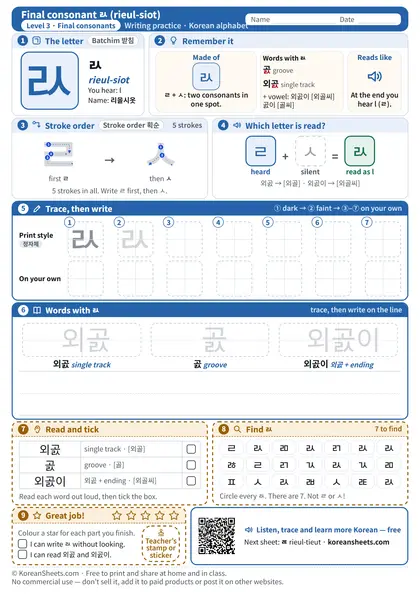
Worksheet · Level 1 · Letters
Korean double final consonant tracing worksheet: ㄽ (rieul siot)
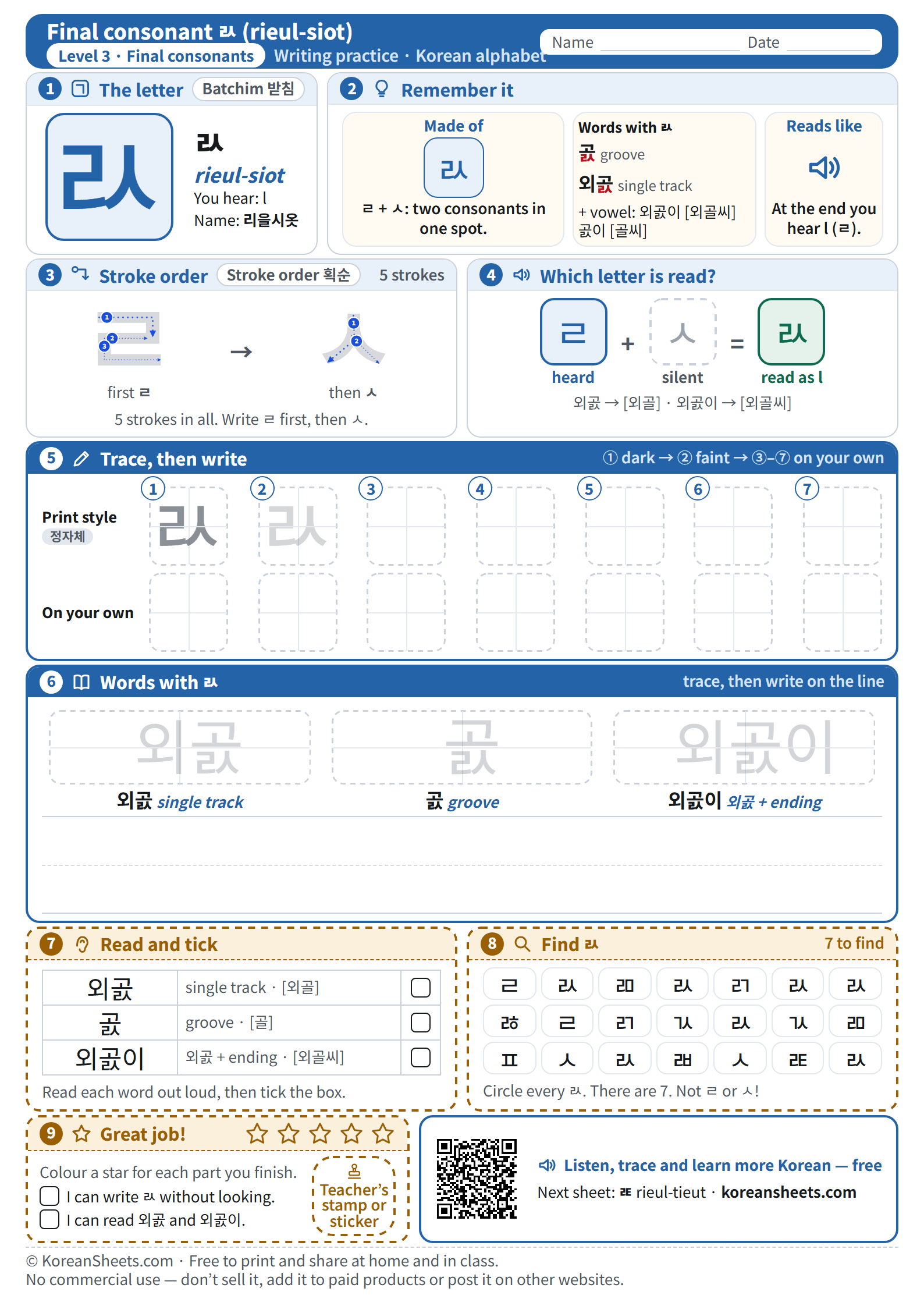
The one-page rieul siot ㄽ sheet shows which of ㄹ and ㅅ is read, traces ㄽ, and practises the words 외곬, 곬.
- 1 page
- A4 · US Letter
- PDF · 84 KB
- Free · no sign-up
Want more? Get a printable pack of Hangul letters
Worksheet information
- How to use
- Decide which letter of ㄽ you hear, trace it in 5 strokes, then practice 외곬 and 곬.
Practice ㄽ
For ㄽ (rieul-siot), read each word aloud in two forms, bare and with its vowel ending, and keep going until [외골] and [외골씨] come out without thinking.
A one-page worksheet for ㄽ (rieul-siot) sits beside this guide, with the stroke order, space for tracing and a spot-the-letter game.
Try it yourself

Put rieul siot ㄽ, l, into the builder and read the block it makes. Open the syllable builder with ㄽ ready
ㄽ (리을시옷) — FAQ
Which sound does ㄽ make when it ends a syllable?
Only ㄹ is heard, as a short l.
When is ㄽ read with both letters?
Before a vowel the ㅅ moves forward and turns tense. Examples: 외곬이 is [외골씨], and 곬이 is [골씨].
How often will I need ㄽ?
Rarely. It appears in very few words, so the pattern matters more than the letter: the first letter, ㄹ, is read at the end and the ㅅ turns into a tense ss before a vowel.
How many strokes is ㄽ?
ㄽ has five strokes: ㄹ takes 3 strokes and ㅅ takes 2 strokes.
Last updated: