
ㄵ (니은지읒): the Korean double final consonant
ㄵ joins ㄴ and ㅈ under a vowel. Learn which letter is heard. Hear 앉다 alone as 안따 and linked as 안자요; print the free ㄵ worksheet.
What sound does ㄵ make at the end of a syllable?
ㄵ (nieun jieut) is a double final consonant made of ㄴ and ㅈ (jieut), and at the end of a syllable only the first letter, ㄴ (nieun), is heard as a short n. ㄵ is common in just two verbs, 앉다 (to sit) and 얹다 (to put on top), so it is learned almost entirely through these words. A good word to start with is 앉다 (to sit): alone it is read [안따], and with a vowel ending 앉아요 it is read [안자요].
ㄵ nieun jieut: parts, sound and strokes
ㄵ 니은지읒Korean double final consonant
ㄵ joins ㄴ and ㅈ; at the end of a syllable the first letter, ㄴ, is heard.
ㄵ at a glance
Which sound ㄵ makes at the end
니은지읒ㄵ before a vowel
| Word | Alone | Linked |
|---|---|---|
| 앉다 (to sit) | [안따] | 앉아요 [안자요] |
| 얹다 (to put on top) | [언따] | 얹어요 [언저요] |
Before a vowel such as the polite ending 아요, the ㅈ moves over to start the next syllable and keeps its plain j sound: 앉아요 is [안자요] and 얹어요 is [언저요].
Say 앉다 (to sit) on its own first, as [안따], and then 앉아요, which is read [안자요]. Say 얹다 (to put on top) on its own first, as [언따], and then 얹어요, which is read [언저요].
More forms of ㄵ to listen for
| Form | Reading |
|---|---|
| 앉고 | [안꼬] |
| 앉지 | [안찌] |
| 앉는 | [안는] |
In a verb stem the consonant after ㄵ is made tense, so endings such as -고 and -지 start with a tight sound, while -는 stays plain.
With ㄵ (nieun-jieut), say these forms aloud and compare each reading with the spelling: 앉고 [안꼬], 앉지 [안찌], 앉는 [안는].
Think of ㅈ as a quiet passenger on 앉다 who only gets off when a vowel pulls into the station.
Exceptions and special cases for ㄵ
The tense sound after ㄵ belongs to verb stems. Nouns and other word types do not get it automatically, so check how the word is actually spoken instead of applying the verb rule everywhere.
A common slip with ㄵ
Learners often say 앉다 as “an-ja-da”, giving the ㅈ its own syllable. The ㅈ is silent in the dictionary form and only appears when a vowel ending follows.
Link the two forms in one breath: 앉다 → 앉아요. The first loses the ㅈ, the second brings it back as 자. Try it with 얹다 → 얹어요 too.
How to write ㄵ
Trace nieun jieut ㄵ with a finger, mouse or pen: start at the numbered dot, follow the dotted arrow, and press Clear to try again.
Print style 정자체
Follow the numbers and dotted arrows
Handwriting 필기체
Same stroke order as print style
The two letters inside ㄵ
Where ㄵ sits in a block
Words that use ㄵ
 Words with ㄵ
With ㄵ (nieun-jieut), these words are the ones to learn first for ㄵ (nieun-jieut); check the reading column before you move on.
ㄵ among the other double finals
ㄵ writing worksheet (free printable)
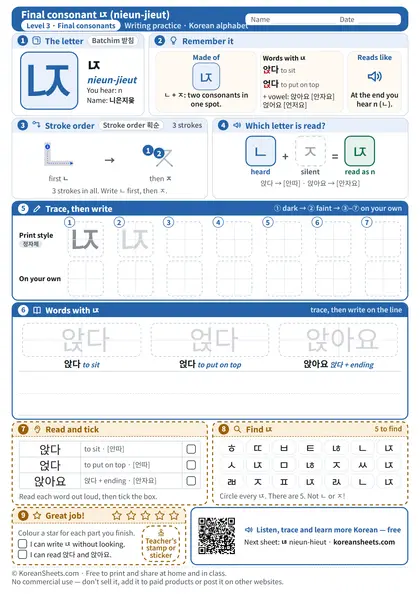
Worksheet · Level 1 · Letters
Korean double final consonant tracing worksheet: ㄵ (nieun jieut)
The one-page nieun jieut ㄵ sheet shows which of ㄴ and ㅈ is read, traces ㄵ, and practises the words 앉다, 얹다.
- 1 page
- A4 · US Letter
- PDF · 86 KB
- Free · no sign-up
Want more? Get a printable pack of Hangul letters
Worksheet information
- How to use
- Decide which letter of ㄵ you hear, trace it in 3 strokes, then practice 앉다 and 얹다.
Practice ㄵ
Switch between [안따] and [안자요] again and again until the change feels natural.
Print the ㄵ (nieun-jieut) worksheet when you are ready: one page, built from the facts above, with the strokes to trace and a letter-spotting game.
Try it yourself

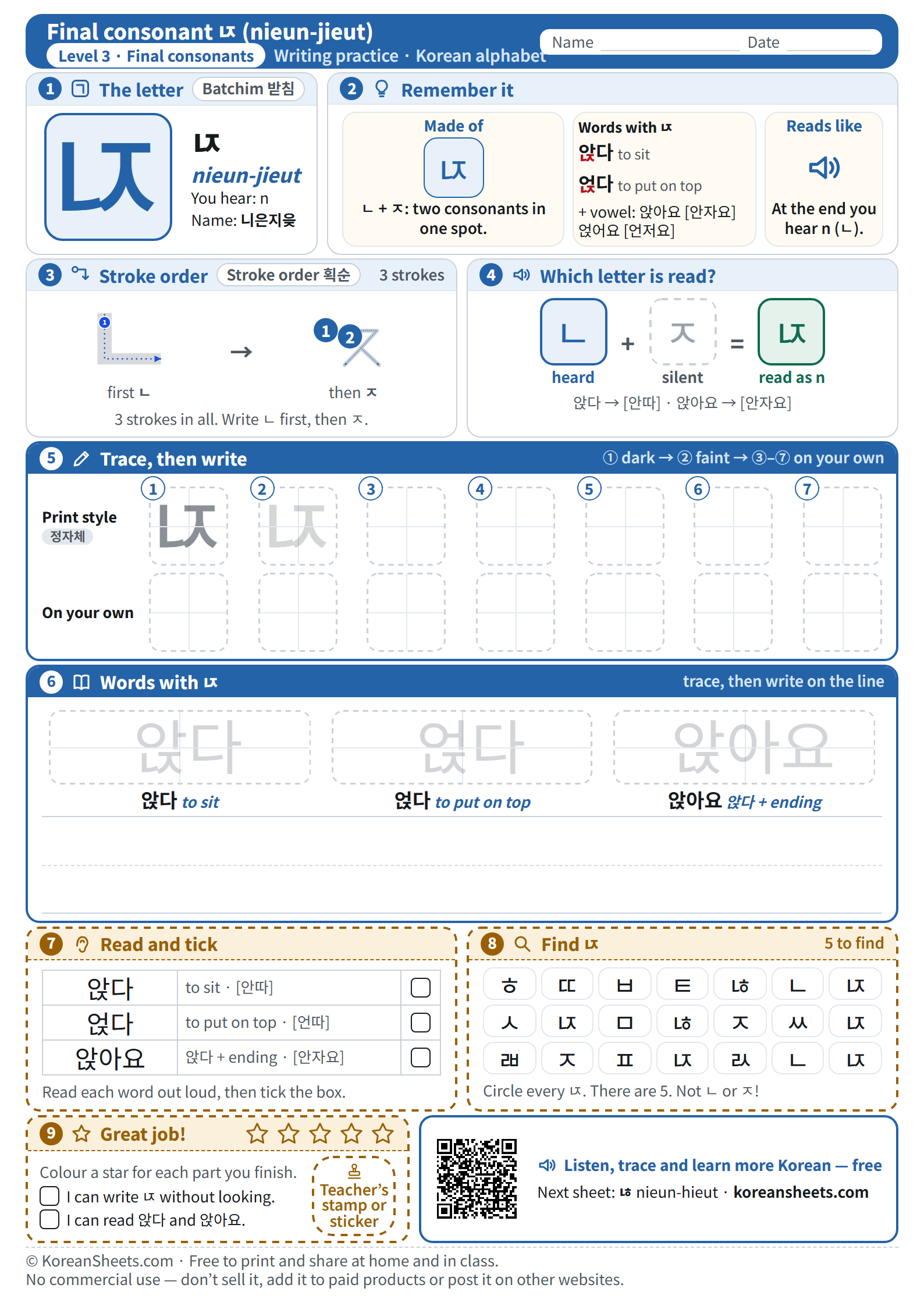
Put nieun jieut ㄵ, n, into the builder and read the block it makes. Open the syllable builder with ㄵ ready
ㄵ (니은지읒) — FAQ
Which sound does ㄵ make when it ends a syllable?
Only ㄴ is heard, as a short n.
When is ㄵ read with both letters?
Before a vowel such as the polite ending 아요, the ㅈ moves over to start the next syllable and keeps its plain j sound. Examples: 앉아요 is [안자요] and 얹어요 is [언저요].
Is ㄵ read “nj” anywhere?
Only in the sense that the ㄴ and ㅈ both appear once a vowel follows: 앉아요 is [안자요], with the ㄴ ending one syllable and the ㅈ starting the next. At the end of a word the ㅈ is not heard.
How many strokes is ㄵ?
ㄵ has three strokes: ㄴ takes 1 stroke and ㅈ takes 2 strokes.
Last updated: