
Ui in Korean: the Vowel ㅢ (의)
ㅢ is the Korean vowel 의 (ui): ui, from eu sliding to ee. See where ㅢ sits in a block, with 의사 and 의자; trace ㅢ in 2 strokes, print the ㅢ worksheet.
What is Ui in Korean, the Korean vowel ㅢ?
Ui in Korean is ㅢ, the vowel called 의, read ui, from eu sliding to ee. As a vowel built from a horizontal part and a vertical part, it is placed to the right of and below the consonant; writing it takes 2 strokes. It opens the words 의자 (chair) and 의사 (doctor).
Ui in Korean ㅢ: sound, strokes, place and mirror pair
ㅢ Ui in KoreanKorean vowel · compound
ㅢ is read ui; it sits right and below the consonant.
ㅢ (Ui) at a glance
Two ways to remember ㅢ
 Shape
 Words with
How to say ㅢ
의Where ㅢ sits in a block
ㅏ ㅐ ㅑ ㅒ ㅓ ㅔ ㅕ ㅖ ㅣ
ㅗ ㅛ ㅜ ㅠ ㅡ
ㅘ ㅙ ㅚ ㅝ ㅞ ㅟ ㅢ
Because ㅢ has both a vertical and a horizontal part, it wraps around the consonant: the horizontal part goes below and the vertical part stands on the right, as in 긔 (gui).
A bare ㅢ (ui) sound needs a consonant in front, because Korean spelling always wants one: 의 (ui) uses the silent ㅇ.
How to write ㅢ
Trace Ui in Korean ㅢ with a finger, mouse or pen: start at the numbered dot, follow the dotted arrow, and press Clear to try again.
Print style 정자체
Follow the numbers and dotted arrows
Handwriting 필기체
Same stroke order as print style
With ㅢ (ui), the whole vowel is two strokes.
Learn three words, one for each rule: 의자 (chair), 희망 (hope) and the particle 의 in 나의 (my). Say each the way its rule says.
ㅢ and its look-alikes
| Letter | Name | Sound |
|---|---|---|
| ㅟ | 위 (wi) | wi, as in we |
| ㅢ | 의 (ui) | ui, eu sliding to ee |
ㅢ has three readings: 의사 [의사] at the start of a word, 희망 [히망] after a consonant, and the particle 의 as [의] or [에], as in 우리의 [우리의/우리에].
Learners often say every ㅢ as u-i. After a consonant it is plain [ㅣ]: 흰색 (white) is [힌색].
Its closest neighbour is ㅣ (i); compare the two in the table below.
Why ㅢ looks the way it does
ㅢ is a compound vowel: its two parts are written side by side and the sound slides from one to the other.
Words that use ㅢ
| Word | Reading | Meaning |
|---|---|---|
| 무늬 | [무니] mu-ni | pattern (noun) |
| 회의 | hoe-ui | meeting (noun) |
In 의자 (chair), ㅢ sits in the first block 의, which is ㅇㅢ and is read ui.
In 회의 (meeting), ㅢ sits in the second block 의, which is ㅇㅢ and is read ui.
In 무늬 (pattern), ㅢ sits in the second block 늬, which is ㄴㅢ and is read nui.
In 희망 (hope), ㅢ sits in the first block 희, which is ㅎㅢ and is read hui.
In 의사 (doctor), ㅢ sits in the first block 의, which is ㅇㅢ and is read ui.
Syllables you can build with ㅢ
Put ㅢ (ui) behind each basic consonant and the row starts 긔 (gui), 늬 (nui), 듸 (dui), and 릐 (rui); only the front of the block changes.
ㅢ (ui) is easiest to hear by reading the whole row aloud, once for every opening position.
Try it yourself

Change the first consonant and read the block that ㅢ makes, such as 의. Open the syllable builder with ㅢ ready
ㅢ with a final consonant
Under the silent ㅇ and ㅢ, six common finals give 읙 (uik), 읜 (uin), 읠 (uil), 읨 (uim), 읩 (uip), 읭 (uing).
Listen for ㅢ (ui) in the middle of each block, because it keeps its shape while the final consonant closes the sound.
Close 의 with ㄱ and you read 읙 (uik), closing on a quiet k. Close 의 with ㄴ and you read 읜 (uin), closing on a hummed n. Close 의 with ㄹ and you read 읠 (uil), closing on a tongue-tip l.
Close 의 with ㅁ and you read 읨 (uim), closing on a lip-closed m. Put ㅂ at the bottom of 의 for 읩 (uip), closing on a lip-closed p. Add ㅇ under 의 and you get 읭 (uing), closing on the ng of song.
ㅢ writing worksheet (free printable)
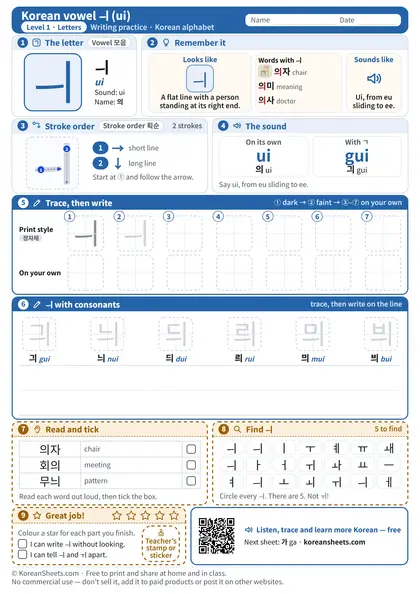
Worksheet · Level 1 · Letters
Korean letter tracing worksheet: ㅢ (ui)
The one-page Ui in Korean ㅢ sheet shows ㅢ in 2 strokes, traces it, writes it with six consonants (긔 늬 듸 릐 믜 븨) and ends with a game of finding ㅢ among look-alikes.
- 1 page
- A4 · US Letter
- PDF · 88 KB
- Free · no sign-up
Want more? Get a printable pack of Hangul letters
Worksheet information
- How to use
- Say ㅢ out loud, trace its 2 strokes, then write it with six consonants.
Practice ㅢ
Continue with ㅣ (i), the last vowel. Then read 의미, 의자 and 흰색 and trace ㅢ.
Print the ㅢ (ui) worksheet when you are ready: one page, built from the facts above, with the strokes to trace and a letter-spotting game.
Try it yourself
Put Ui in Korean ㅢ, ui, into the builder and read the block it makes. Open the syllable builder with ㅢ ready
ㅢ (Ui in Korean) — FAQ
What is the ㅢ pronunciation?
Say ui, from eu sliding to ee with a loose jaw, first alone and then in 의자.
How do you write ㅢ and which position does it take in a syllable block?
ㅢ takes 2 strokes: Draw the horizontal line of ㅡ. Draw the vertical line of ㅣ on the right. In a block it sits to the right of and below the consonant.
How do you say ㅢ in Korean?
ㅢ (ui) is ㅡ gliding into ㅣ at the start of a word, as in 의사 (doctor). After a consonant it is [ㅣ], as in 희망 [히망].
How many strokes is ㅢ?
ㅢ has 2 strokes: the horizontal line of ㅡ, then the vertical line of ㅣ.
Last updated: