
Hello in Korean: 안녕하세요
안녕하세요 (annyeonghaseyo) is how you say hello in Korean. See every form from casual to formal, hear it, build it letter by letter and trace each block stroke by stroke.
How do you say hello in Korean?
Hello in Korean is 안녕하세요 (annyeonghaseyo), the polite greeting you can say to almost anyone at any time of day. With close friends it shortens to 안녕 (annyeong), and in very formal settings it becomes 안녕하십니까.
Hello in Korean 안녕하세요: sound, letters and strokes
안녕하세요 Hello in KoreanKorean phrase
안녕하세요 is read annyeonghaseyo; 3 forms from casual to formal.
Casual, polite and formal hello in Korean
Formal: news anchors, speeches, greeting a large group or a much older stranger.
Polite and safe with almost everyone, including people you do not know.
Casual: close friends, younger siblings and children.
안녕하세요 is the greeting you can say to almost anyone: a shop clerk, a neighbour, a teacher or a person you meet for the first time. It comes from the adjective 안녕하다, whose dictionary meaning is peaceful or well, so the greeting literally asks whether the other person is at peace. Say it at any hour; Korean has no separate morning or evening greeting in daily speech.
Which one to use
Use 안녕하세요 when you are unsure, because it is polite without sounding stiff. Switch to 안녕 only when the other person already speaks to you in casual Korean. 안녕하십니까 fits formal settings such as a job interview or a presentation.
How to pronounce 안녕하세요
안녕하세요Say it in five even beats: an – nyeong – ha – se – yo. The first beat sounds like "on" with a short a, the second like "nyuhng", and the last two rhyme with "say yo". Keep the pitch flat and let it rise a little on 요 if you want to sound friendly.
안녕하세요 letter by letter
How to write 안녕하세요 stroke by stroke
Write 안녕하세요 one block at a time: 안, 녕, 하, 세, 요. Inside every block go from the first consonant to the vowel and then the final consonant, following the numbered strokes.
Trace an 안 with a finger, mouse or pen: start at the numbered dot, follow the dotted arrow, and press Clear to try again.
Print style 정자체
Follow the numbers and dotted arrows
Handwriting 필기체
Same stroke order as print style
Trace nyeong 녕 with a finger, mouse or pen: start at the numbered dot, follow the dotted arrow, and press Clear to try again.
Print style 정자체
Follow the numbers and dotted arrows
Handwriting 필기체
Same stroke order as print style
Trace ha 하 with a finger, mouse or pen: start at the numbered dot, follow the dotted arrow, and press Clear to try again.
Print style 정자체
Follow the numbers and dotted arrows
Handwriting 필기체
Same stroke order as print style
Trace se 세 with a finger, mouse or pen: start at the numbered dot, follow the dotted arrow, and press Clear to try again.
Print style 정자체
Follow the numbers and dotted arrows
Handwriting 필기체
Same stroke order as print style
Trace yo 요 with a finger, mouse or pen: start at the numbered dot, follow the dotted arrow, and press Clear to try again.
Print style 정자체
Follow the numbers and dotted arrows
Handwriting 필기체
Same stroke order as print style
When to say 안녕하세요
안녕하세요 in example sentences
| Korean | English |
|---|---|
| 안녕하세요, 저는 민수예요. | Hello, I am Minsu. |
| 선생님, 안녕하세요! | Hello, teacher! |
| 안녕, 오늘 학교 가? | Hi, are you going to school today? |
| Korean | English |
|---|---|
| 선생님, 안녕하세요? / 그래, 너도 잘 지내지? | A: Hello, teacher. / B: Hello. You are doing well too, right? |
| 박지수 선생님, 안녕하세요? | Hello, Teacher Park Jisu. |
안녕하세요 in a short conversation
| Who | Korean | English |
|---|---|---|
| A | 안녕하세요. 처음 뵙겠습니다. | Hello. Nice to meet you (for the first time). |
| B | 안녕하세요. 반갑습니다. | Hello. Glad to meet you. |
More ways to say hello in Korean
Only when you pick up or start a phone call.
Right after the first hello with someone new.
A very polite first greeting in formal meetings.
When you meet someone after weeks or months.
A friendly greeting; it shows care, not an invitation.
A common mistake with 안녕하세요
Learners often say 안녕 to an older person because it is short and appears in songs. With anyone older than you or anyone you just met, use 안녕하세요 instead.
Culture note
A greeting is usually paired with a small bow of the head; with teachers and elders the bow gets a little deeper.
How to practice
Practise the rhythm in two parts, 안녕 + 하세요, then join them. Writing the five syllable blocks one by one helps you see the two ㄴ sounds meeting.
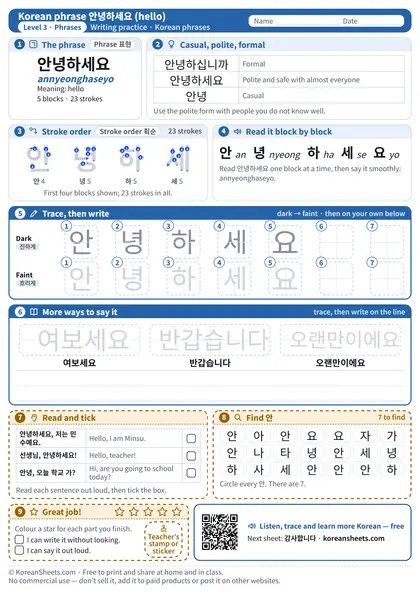
안녕하세요 writing worksheet (free printable)
Worksheet · Level 3 · Phrases
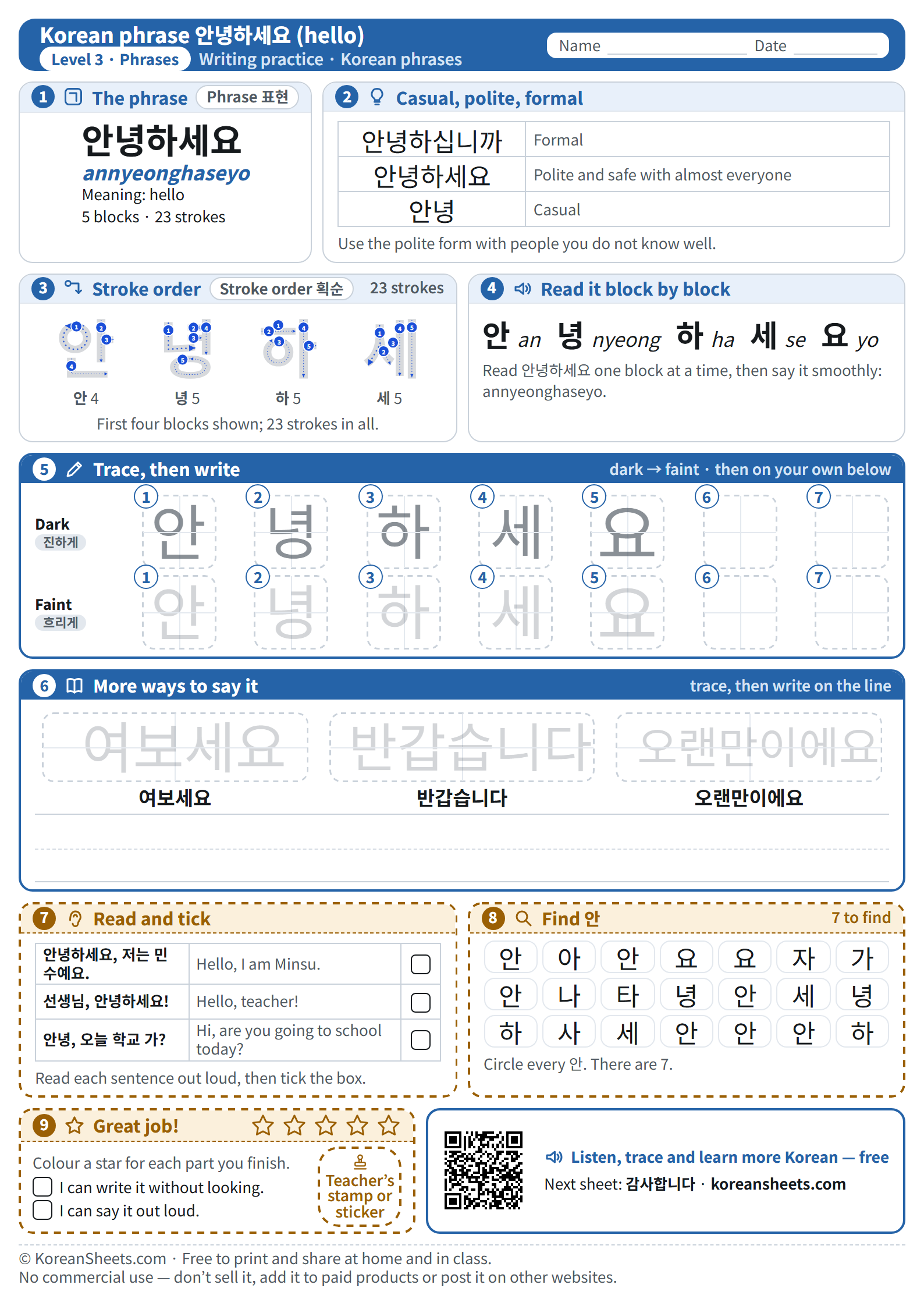
Korean phrase tracing worksheet: 안녕하세요 (hello)
One A4 page for 안녕하세요: trace its 5 blocks (23 strokes), write other ways to say it, read three sentences and find 안.
- 1 page
- A4 · US Letter
- PDF · 102 KB
- Free · no sign-up
Want more? See all korean phrases
Worksheet information
- How to use
- Say 안녕하세요 out loud, trace each block from dark to faint, then write it on the line.
Use of the worksheet:
© KoreanSheets.com · Free to print and share at home and in class. No commercial use — don’t sell it, add it to paid products or post it on other websites. The QR code on the sheet opens this page to listen and trace on screen.
What to learn next
Hello in Korean — FAQ
How do you say hello in Korean?
안녕하세요 (annyeonghaseyo) is the standard polite hello. With close friends you can shorten it to 안녕.
Is 안녕 rude?
안녕 is not rude among friends, but it is casual. To an older person or a stranger it sounds too familiar, so use 안녕하세요.
What is the difference between 안녕하세요 and 안녕하십니까?
안녕하십니까 is the formal version used in speeches, broadcasts and very formal meetings. 안녕하세요 is the everyday polite form.
How do you say hi in Korean?
안녕 (annyeong) is the casual hi between friends. To someone you do not know well, even a quick hi should be 안녕하세요.
How do you write hello in Korean?
Hello is written 안녕하세요 in Hangul: five syllable blocks, 안 + 녕 + 하 + 세 + 요. Each block is one beat when you say it.
How do you say hello on the phone in Korean?
여보세요 (yeoboseyo). It is only for answering or starting a phone call; face to face you say 안녕하세요.
Is there a separate good afternoon or good evening in Korean?
Not in daily speech. 안녕하세요 works in the morning, afternoon and evening, so one greeting covers all three.
Last updated: