
Thank you in Korean: 감사합니다
감사합니다 (gamsahamnida) is how you say thank you in Korean. See every form from casual to formal, hear it, build it letter by letter and trace each block stroke by stroke.
How do you say thank you in Korean?
Thank you in Korean is 감사합니다 (gamsahamnida), the polite form you can use with anyone. 고맙습니다 is just as polite, 고마워요 is softer, and 고마워 is the casual thank you for close friends.
Thank you in Korean 감사합니다: sound, letters and strokes
감사합니다 Thank you in KoreanKorean phrase
감사합니다 is read gamsahamnida; 5 forms from casual to formal.
Casual, polite and formal thank you in Korean
Formal and polite: customers, staff, teachers, strangers.
formal: strong thanks, when someone went out of their way
Equally polite; a native Korean word, slightly warmer in tone.
Polite but relaxed: coworkers or acquaintances your age.
Casual: close friends and younger family members.
감사합니다 is the thank-you you hear in shops, offices, buses and on the phone. It is built on the adjective 감사하다 (thankful) in the formal ending -ㅂ니다, so it sounds respectful but not cold. Say it when someone hands you something, holds a door, or finishes helping you.
Which one to use
감사합니다 and 고맙습니다 are both safe with anyone. 고마워 is only for people who talk to you in casual speech. Staff and customers use 감사합니다 with each other all day.
How to pronounce 감사합니다
감사합니다Sound rule
Read it as gam-sa-ham-ni-da (gamsahamnida). The ㅂ at the end of 합 turns into an m sound before ㄴ, so you hear 함니다, not 합니다.
감사합니다 letter by letter
How to write 감사합니다 stroke by stroke
Trace gam 감 with a finger, mouse or pen: start at the numbered dot, follow the dotted arrow, and press Clear to try again.
Print style 정자체
Follow the numbers and dotted arrows
Handwriting 필기체
Same stroke order as print style
Trace sa 사 with a finger, mouse or pen: start at the numbered dot, follow the dotted arrow, and press Clear to try again.
Print style 정자체
Follow the numbers and dotted arrows
Handwriting 필기체
Same stroke order as print style
Trace hap 합 with a finger, mouse or pen: start at the numbered dot, follow the dotted arrow, and press Clear to try again.
Print style 정자체
Follow the numbers and dotted arrows
Handwriting 필기체
Same stroke order as print style
Trace ni 니 with a finger, mouse or pen: start at the numbered dot, follow the dotted arrow, and press Clear to try again.
Print style 정자체
Follow the numbers and dotted arrows
Handwriting 필기체
Same stroke order as print style
Trace da 다 with a finger, mouse or pen: start at the numbered dot, follow the dotted arrow, and press Clear to try again.
Print style 정자체
Follow the numbers and dotted arrows
Handwriting 필기체
Same stroke order as print style
When to say 감사합니다
감사합니다 in example sentences
| Korean | English |
|---|---|
| 도와주셔서 감사합니다. | Thank you for helping me. |
| 선물 고마워요. | Thanks for the gift. |
| 와 줘서 고마워. | Thanks for coming. |
| Korean | English |
|---|---|
| 이것 좀 드셔 보세요. / 네, 감사합니다. | A: Please try some of this. / B: Yes, thank you. |
| 이번 행사에 귀한 시간을 내어 자리해 주셔서 감사합니다. | Thank you for taking your valuable time to join this event. |
감사합니다 in a short conversation
| Who | Korean | English |
|---|---|---|
| A | 여기 영수증이요. | Here is your receipt. |
| B | 감사합니다. 안녕히 계세요. | Thank you. Goodbye. |
More ways to say thank you in Korean
A softer version of 감사합니다 for daily use.
When someone really helped you.
To staff, coworkers or a teacher after work is done.
Said before a meal someone made or paid for.
Said after the meal to the host or the cook.
A common mistake with 감사합니다
Many learners write the spelling as it sounds, 감사함니다. The sound changes, but the spelling keeps ㅂ: 감사합니다.
Culture note
When receiving something from an older person, Koreans often take it with both hands while saying 감사합니다.
How to practice
Say it at the end of every practice conversation. Tracing the block 합 helps you remember the hidden ㅂ.
감사합니다 writing worksheet (free printable)
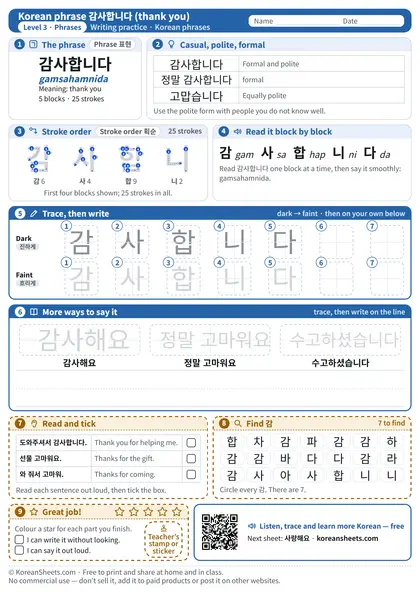
Worksheet · Level 3 · Phrases
Korean phrase tracing worksheet: 감사합니다 (thank you)
One A4 page for 감사합니다: trace its 5 blocks (25 strokes), write other ways to say it, read three sentences and find 감.
- 1 page
- A4 · US Letter
- PDF · 98 KB
- Free · no sign-up
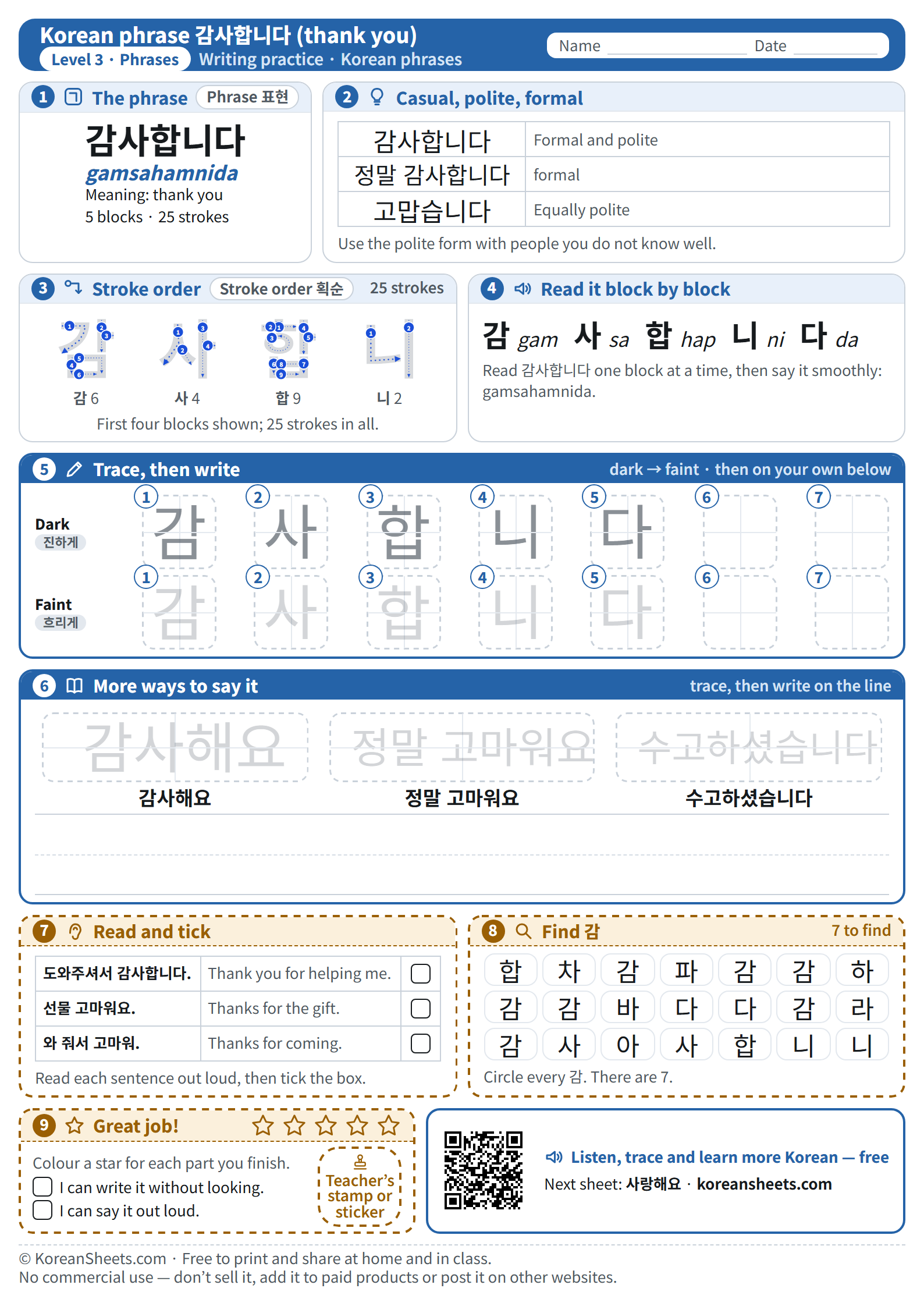
Want more? See all korean phrases
Worksheet information
- How to use
- Say 감사합니다 out loud, trace each block from dark to faint, then write it on the line.
Use of the worksheet:
© KoreanSheets.com · Free to print and share at home and in class. No commercial use — don’t sell it, add it to paid products or post it on other websites. The QR code on the sheet opens this page to listen and trace on screen.
What to learn next
Thank you in Korean — FAQ
How do you say thank you in Korean?
감사합니다 (gamsahamnida) is the most common polite thank you. 고맙습니다 means the same and is just as polite.
Is 감사합니다 or 고맙습니다 more polite?
감사합니다 and 고맙습니다 are equally polite. 감사 comes from Chinese characters and 고맙다 is a native word, so the choice is mostly habit.
How do you say thank you in Korean informally?
고마워 (gomawo). Say it only to close friends or people younger than you; with everyone else use 고마워요 or 감사합니다.
How do you say thank you very much in Korean?
정말 감사합니다 or 너무 감사합니다. 정말 means really and adds warmth without changing the politeness.
How do you reply to thank you in Korean?
아니에요 (it is nothing) or 천만에요 (you are welcome). 아니에요 sounds more natural in daily speech.
How is gamsahamnida written in Hangul?
감사합니다 — five blocks: 감 + 사 + 합 + 니 + 다.
Last updated: