
No in Korean: 아니요
아니요 (aniyo) is how you say no in Korean. See every form from casual to formal, hear it, build it letter by letter and trace each block stroke by stroke.
What is the Korean word for no?
The Korean word for no is 아니요 (aniyo), the polite no you can say to anyone; in speech it often shortens to 아뇨. Between friends the casual no is 아니 (ani), and 아닙니다 is the formal no.
No in Korean 아니요: sound, letters and strokes
아니요 No in KoreanKorean phrase
아니요 is read aniyo; 3 forms from casual to formal.
Casual, polite and formal no in Korean
Formal: answering a superior or in an interview.
Polite: the normal no with anyone.
Casual: friends and younger family.
아니요 is the polite no. You use it to answer a yes-no question, to decline an offer of food or help, and to correct someone gently. Its short casual form is 아니.
Which one to use
아니요 is safe with everyone. 아니 is casual. When refusing an offer, Koreans often add a softener: 아니요, 괜찮아요 (No, I'm fine).
How to pronounce 아니요
아니요Say a – ni – yo, three short beats with no stress. 아뇨 squeezes the last two into one: "a-nyo". 아니 is just "a-ni".
Sound rule
Read it as a-ni-yo (aniyo). In speech it often shortens to 아뇨 (anyo), which the dictionary also lists.
아니요 letter by letter
How to write 아니요 stroke by stroke
Write 아니요 one block at a time: 아, 니, 요. Inside every block go from the first consonant to the vowel and then the final consonant, following the numbered strokes.
Trace a 아 with a finger, mouse or pen: start at the numbered dot, follow the dotted arrow, and press Clear to try again.
Print style 정자체
Follow the numbers and dotted arrows
Handwriting 필기체
Same stroke order as print style
Trace ni 니 with a finger, mouse or pen: start at the numbered dot, follow the dotted arrow, and press Clear to try again.
Print style 정자체
Follow the numbers and dotted arrows
Handwriting 필기체
Same stroke order as print style
Trace yo 요 with a finger, mouse or pen: start at the numbered dot, follow the dotted arrow, and press Clear to try again.
Print style 정자체
Follow the numbers and dotted arrows
Handwriting 필기체
Same stroke order as print style
When to say 아니요
아니요 in example sentences
| Korean | English |
|---|---|
| 아니요, 저는 학생이 아니에요. | No, I am not a student. |
| 아니요, 괜찮아요. | No, thank you. (I am fine.) |
| 아니, 그거 아니야. | No, that is not it. |
| Korean | English |
|---|---|
| 조금 더 드시겠습니까? / 아니요, 저는 배가 부릅니다. | A: Would you like some more? / B: No, I'm full. |
| 선생님의 질문에 그 학생은 “예”, “아니요”로 짧게 대답했다. | The student answered the teacher's questions briefly with 'yes' or 'no'. |
아니요 in a short conversation
| Who | Korean | English |
|---|---|---|
| A | 봉투 필요하세요? | Do you need a bag? |
| B | 아니요, 괜찮아요. | No, I am fine. |
More ways to say no in Korean
아니요 compared with other ways to say no
| Korean | Meaning | When you use it |
|---|---|---|
| 아니요 | no | The normal polite no. |
| 아뇨 | no | A shorter spoken form of 아니요. |
| 아니 | no / no way | Casual no, or surprise between friends. |
| 아니에요 | not at all | Denying something or answering thanks. |
| 괜찮아요 | no, thanks | Declining an offer politely. |
| 싫어요 | I don’t want to | A blunt refusal; can sound rude. |
A common mistake with 아니요
Answering a negative question, learners say 아니요 to mean 'I didn't'. To 'You didn't go?' (안 갔어요?), 아니요 means 'No, I did go.'
Culture note
Declining food offered by a host is often done twice before accepting; a light 아니요, 괜찮아요 is a normal first reply.
How to practice
Pair it with 괜찮아요 and practise polite refusals: 아니요, 괜찮아요.
Declining without sounding rude
Koreans often decline an offer with 괜찮아요 (I’m fine) rather than a bare 아니요. Adding 감사합니다 after it, 괜찮아요, 감사합니다, makes the refusal warm.
아니 as an exclamation
Said quickly with surprise, 아니! works like "Wait, what?" or "No way!". It shows surprise, not a refusal, and is used among friends and family.
아니요 writing worksheet (free printable)
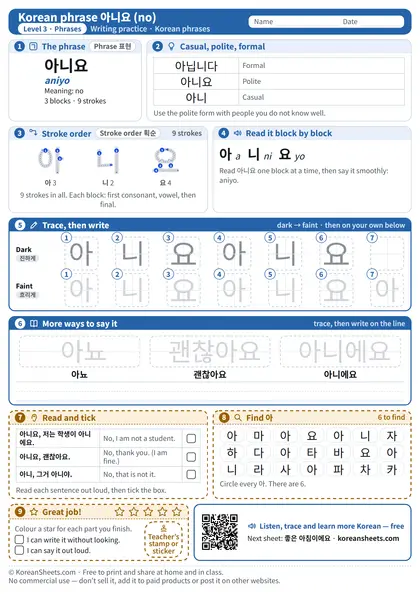
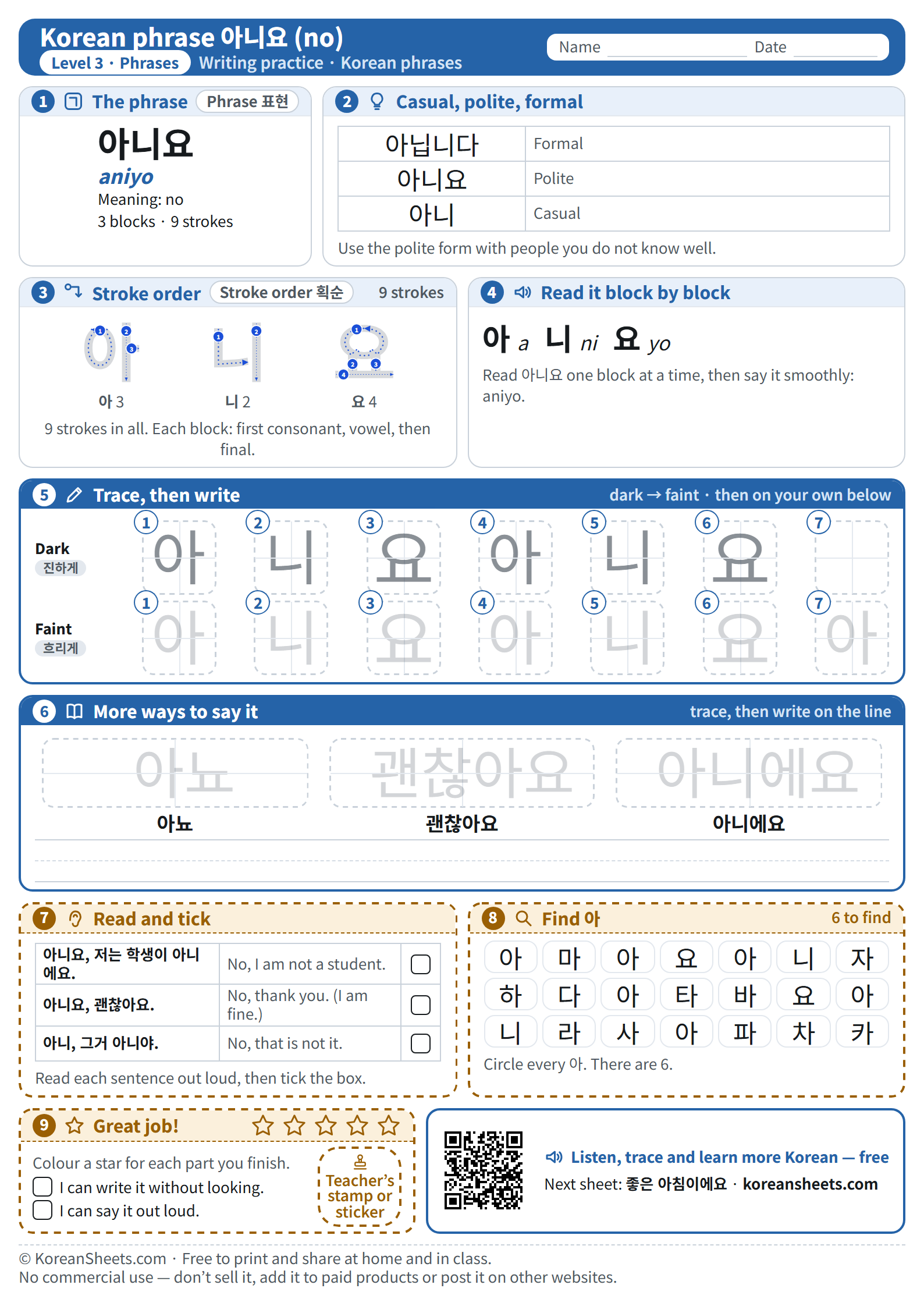
Worksheet · Level 3 · Phrases
Korean phrase tracing worksheet: 아니요 (no)
One A4 page for 아니요: trace its 3 blocks (9 strokes), write other ways to say it, read three sentences and find 아.
- 1 page
- A4 · US Letter
- PDF · 92 KB
- Free · no sign-up
Want more? See all korean phrases
Worksheet information
- How to use
- Say 아니요 out loud, trace each block from dark to faint, then write it on the line.
Use of the worksheet:
© KoreanSheets.com · Free to print and share at home and in class. No commercial use — don’t sell it, add it to paid products or post it on other websites. The QR code on the sheet opens this page to listen and trace on screen.
What to learn next
No in Korean — FAQ
What is the Korean word for no?
아니요 (aniyo) is the polite no; 아니 is casual and 아닙니다 is formal.
Is 아뇨 correct?
아뇨 is the dictionary's short form of 아니요 and is common in speech.
How do you say no thank you in Korean?
아니요, 괜찮아요 — "No, I am fine." Koreans rarely add a separate thank you when declining.
How do you say no in Korean informally?
아니 (ani). Use it only with friends or younger people.
What does 아니에요 mean?
아니에요 means "it is not" or "not at all". It is also a common reply to thank you: 아니에요 = it is nothing.
How do you say I don’t want it in Korean?
싫어요 is a direct "I don’t want to" and can sound blunt. To refuse politely, say 괜찮아요 or 아니요, 괜찮아요.
Last updated: